Let’s be straight with each other. If you’re carrying credit card debt right now, you’re not alone — and you’re definitely not failing. You’re dealing with a system that has been quietly squeezing every American cardholder for the past four years.
Here’s the cold reality: as of the fourth quarter of 2025, Americans collectively owe $1.277 trillion in credit card debt, according to the Federal Reserve Bank of New York; its Q2 2026 report put balances at $1.263 trillion (per the New York Fed, checked Oct. 23, 2026). If you’re only making minimum payments at a 22% interest rate, you’re essentially renting your own debt at a price that’s quietly bleeding your paycheck every month.
The good news? There’s a legal, straightforward way to stop that interest clock — a balance transfer credit card with a 0% introductory APR. In 2026, some of these offers last up to 21 months. That’s nearly two full years to pay down what you owe without a single dollar going to interest.
This guide covers everything: which cards are the best right now, how balance transfers actually work, who qualifies, what the fees look like, and — most importantly — how to build a realistic payoff plan so you come out the other side debt-free instead of back at square one.
If you carry a balance from month to month, a 0% balance transfer card may save you hundreds — or even thousands — of dollars this year.
What Is a Balance Transfer and How Does It Work?
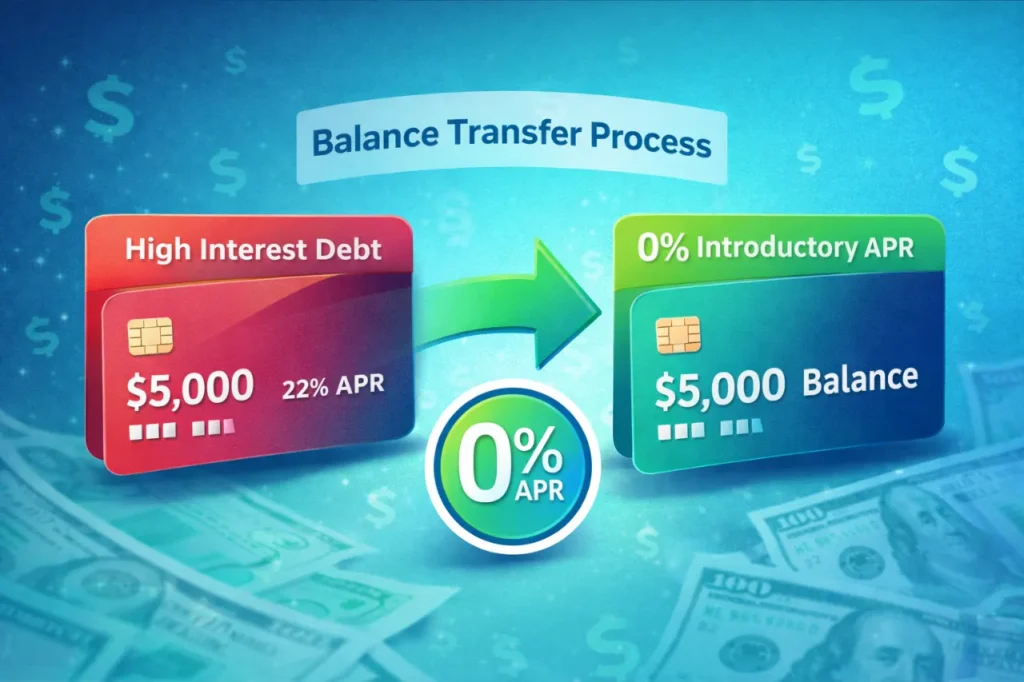
A balance transfer is exactly what it sounds like: you move the balance from one (or more) high-interest credit cards onto a new card — usually one offering a 0% introductory APR for a set number of months. During that introductory window, no interest accrues on the transferred amount. You’re just chipping away at the actual debt.
Here’s a simple example. Say you have $6,000 sitting on a card charging 22% APR. Left on its own with $250 monthly payments, it would take you about 32 months to pay off, and you’d pay roughly $1,980 in interest along the way (assuming a fixed 22% APR, monthly compounding, and no new charges).
Transfer that same $6,000 to a card with an 18-month 0% intro APR and a 3% balance transfer fee, and your total upfront cost is just $180. If you keep making that $250 monthly payment, you’ll pay down $4,500 during the 18-month promo; the remaining $1,680 would then accrue interest at the regular APR (roughly $130 more at 22%, cleared in about 8 more months). To finish within the promo period interest-free, you’d need about $344 a month. The math is pretty convincing.
The balance transfer fee: what you need to know
Almost every balance transfer card charges a fee, typically 3% to 5% of the amount you transfer. On a $5,000 balance, that’s $150 to $250 added to your new balance right away. That may sound frustrating, but compare it to 22% annual interest and it’s a bargain in almost every scenario.
A handful of credit unions and smaller banks do offer no-fee transfers, but they usually come with shorter introductory periods or stricter membership requirements. We’ll cover those options later in this article.
What about purchases made during the intro period?
This is an important distinction. Some 0% APR cards cover both balance transfers and new purchases during the intro period. Others only extend the 0% rate to transferred balances — and any new charges you make immediately start accruing interest at the card’s regular rate, which can be 20% or higher.
The smartest approach while you’re paying down a transferred balance? Don’t use the new card for everyday spending unless it explicitly offers 0% on purchases too. Set it aside. Let the balance shrink.
Best Balance Transfer Credit Cards in 2026
These are the standout offers available right now. Details below come from issuer information; items marked “checked Oct. 15, 2026” were rechecked on that date, and other terms may have changed since publication. Always confirm current terms directly with the issuer before applying, since promotional offers can change.
| Card | 0% APR Period | Transfer Fee | Best For |
| Chase Slate® | 21 months | See Chase’s pricing and terms | Longest no-frills payoff window |
| Citi® Diamond Preferred® | 21 months BT / 12 mo. purchases | See Citi’s terms | Long balance transfer window |
| Wells Fargo Reflect® | 21 months | Not confirmed; see Wells Fargo’s current terms | Purchases AND transfers at 0% |
| BankAmericard® | 21 months | 5% (per Bank of America, checked Oct. 15, 2026) | Low ongoing APR after promo |
| Citi Simplicity® | Check Citi’s site for current terms | Check Citi’s site for current terms | See Citi for current terms |
| U.S. Bank Shield™ Visa® | 21 billing cycles | 5% (min $5) (per U.S. Bank, checked Oct. 24, 2026) | Top pick from a major bank |
| Discover it® Cash Back | 15 months | 3% | Rewards + cashback match Year 1 |
| Chase Freedom Unlimited® | 15 months | 3-5% | Rewards earner after payoff period |
1. Chase Slate® — Best Overall for Paying Off Debt Fast
The Chase Slate is built for one purpose: helping you get out of debt without getting buried in interest. It offers a 0% intro APR on both purchases and balance transfers for 21 months from account opening (per Chase, checked Oct. 23, 2026), one of the longest windows available from a major bank.
There’s no annual fee. There’s no rewards program to distract you. This is a focused financial tool, not a lifestyle card. If you have a solid payoff plan and you’re transferring debt from another bank (Chase won’t let you transfer balances between its own cards), this is arguably the cleanest option on the market.
One caveat: you generally need good to excellent credit to get approved; Chase does not publish a minimum score. And a balance transfer fee applies (Chase lists the amount in the card’s pricing and terms), which, on a large balance, adds up. If minimizing that fee matters more to you than maximizing the promotional window, read the Citi Simplicity section next.
2. Citi® Diamond Preferred® — Best for a Long Transfer Window
The Citi Diamond Preferred gives you 21 months at 0% on balance transfers completed within the first four months of opening the account. Check Citi’s site for the current balance transfer fee, including whether a lower introductory fee applies to early transfers.
On purchases, the 0% APR applies for 12 months — shorter than some competitors. But if your primary goal is paying down existing debt rather than financing new spending, that shorter purchase window probably doesn’t matter much. The ongoing variable APR depends on your creditworthiness; Citi does not display the current range on its public card page in a form we could confirm, so check Citi’s site.
3. Wells Fargo Reflect® — Best if You’re Also Making a Big Purchase
Most people think of balance transfer cards as purely debt-payoff tools. But life doesn’t always cooperate. Sometimes you’re carrying existing debt AND facing a major, unavoidable expense — a car repair, a medical bill, a home appliance that just died.
The Wells Fargo Reflect covers both situations with 21 months of 0% APR on purchases AND balance transfers. You can move your existing high-interest debt and finance a new necessity, all without paying interest for nearly two years. It also comes with cell phone protection — up to $600 per claim when you pay your phone bill with the card. That’s a legitimate perk that adds real ongoing value after the promotional period ends.
The transfer fee is 5%, which is on the higher end. And you need to complete your transfers within 120 days of account opening. But for the right situation, this is one of the most versatile debt tools available in 2026.
4. BankAmericard® Credit Card — Best Low Ongoing APR
The BankAmericard offers 21 billing cycles at 0% on purchases and balance transfers made within the first 60 days. What makes it stand out beyond the promotional period is its ongoing APR — it’s lower than many competing cards’, which is reassuring if you’re not completely sure you’ll zero out the balance before the promo ends.
There’s no penalty APR with the BankAmericard. That means if you’re ever late with a payment, your rate won’t automatically spike to 29.99%. That’s a meaningful safety net for people who are juggling bills and occasionally miss a due date, even if only by a day or two.
5. Citi Simplicity® — Best for Avoiding the Transfer Fee Penalty
If you’re transferring a large balance, the difference between a 3% fee and a 5% fee matters. On a $10,000 balance, that’s $200 versus $500 — a $300 difference that you’d have to sit and pay down before you even start making real progress.
For the Citi Simplicity’s balance transfer fee (including any lower introductory fee) and the length of its promotional period, check Citi’s site for current terms. If your math shows that a lower fee saves more than a shorter promotional window would cost, Simplicity can win.
No late fees. No penalty APR. No annual fee. It’s a no-drama option that does exactly what it promises.
6. Discover it® Cash Back — Best for the Person Who Wants Rewards Too
Most hard-core debt payoff advice says to pick a bare-bones card, pay down your balance, and ignore rewards. That’s solid advice. But if you’re the type of person who will absolutely keep using a card after the promo period — and that’s most people — the Discover it can make sense.
You get 15 months at 0% on balance transfers and purchases, with a 3% transfer fee. The real draw is the rewards program: 5% cash back on rotating quarterly categories (groceries, restaurants, gas stations, Amazon, etc.), plus 1% on everything else. And at the end of your first year, Discover matches every dollar of cash back you’ve earned — with no cap. That can easily add up to an extra $150 to $300, depending on your spending.
The 15-month promotional window is shorter than the top-tier options. If you realistically need 18 to 21 months to pay off your debt, look elsewhere. But if 15 months works for you, the Discover it is the best option for building long-term card value after the payoff period.
Who Qualifies for a Balance Transfer Credit Card?
Let’s not sugarcoat this part. Balance transfer cards — especially the ones with the longest 0% APR windows — require good credit. Most issuers look for a FICO score of 670 or higher, and the very best offers typically target people with scores of 720 or higher.
Why does this matter? Because credit card applications do get denied, and each one costs you a hard inquiry. If your credit score is below 670, applying for a top balance transfer card could result in a hard inquiry that dings your score without any benefit.
How to check your credit score for free
Before you apply anywhere, pull your credit report for free at AnnualCreditReport.com — the only federally authorized source for free reports from all three major bureaus (Equifax, Experian, and TransUnion). Review it for errors. Even a small mistake — a late payment that isn’t yours, an account you don’t recognize — can drag your score down and get you denied for cards you’d otherwise qualify for.
Many banks and credit card companies also offer free access to credit scores. Capital One’s CreditWise, Chase Credit Journey, and Discover’s Credit Scorecard all provide your VantageScore or FICO score at no cost and update it regularly.
What if your credit score is below 670?
You have options — they’re just different ones. A few credit unions and smaller regional banks offer no-fee balance transfers with lower credit requirements. Navy Federal Credit Union’s Platinum Credit Card, for example, has no balance transfer fee and competitive ongoing rates, though its intro rate is 0.99% (not 0%) for 12 months (per Navy Federal, checked Oct. 15, 2026) and membership is restricted to members of the military community.
Some secured credit cards also accept transfers, though they require a cash deposit and usually have lower credit limits. If your balance is small enough, this route can still save meaningful interest while you rebuild your credit score.
Another path: a nonprofit credit counseling agency can help you set up a Debt Management Plan (DMP) — a structured payoff arrangement directly with your creditors that often includes reduced interest rates, even if you don’t qualify for new credit. Look for agencies affiliated with the National Foundation for Credit Counseling (NFCC).
How Much Can a Balance Transfer Actually Save You?
The numbers here are more persuasive than any marketing copy. Let’s walk through a few real scenarios based on current average credit card balances and interest rates.
Scenario 1: $5,000 balance at 22% APR
With a $200 monthly payment and no balance transfer:
- Payoff time: approximately 34 months (assuming a fixed 22% APR, monthly compounding, and no new charges)
- Total interest paid: roughly $1,750
- Total paid: about $6,750
With an 18-month 0% balance transfer card and a 3% fee ($150), keeping the same $200 monthly payment:
- Payoff time: about 27 months (about $1,550 remains when the 18-month intro period ends)
- Total fee paid: $150
- Additional interest (on remaining balance after 18 months): approximately $140
- Total paid: about $5,290 — a savings of about $1,460
Scenario 2: $10,000 balance at 22% APR
At $350 per month with no balance transfer:
- Payoff time: approximately 41 months (same assumptions as above)
- Total interest paid: roughly $4,290
With a 21-month 0% transfer card and a 5% fee ($500):
- Payoff at the same $350/month: $7,350 of the balance cleared during the promo period
- Remaining ~$3,150 accrues interest after month 21, but at a much lower outstanding balance
- Total saved vs. staying on the old card: about $3,470 (roughly $4,290 in interest vs. about $820 in fee plus interest)
Even after paying the balance transfer fee, the math almost always favors a transfer over staying on a high-APR card. The only exception is if you can’t commit to a real payoff plan — in which case, you may just be kicking the can down the road.
The Step-by-Step Process: How to Do a Balance Transfer
Step 1: Know exactly what you owe
Log in to every credit card account and write down the current balance, interest rate, and minimum monthly payment for each. This gives you a clear picture of how much you need to transfer and helps you prioritize which debts make the most sense to move first.
High-interest cards — those with APRs above 20% — should be your first targets. If you have a store credit card charging 28% or 29%, that’s a financial emergency that deserves immediate attention.
Step 2: Check your credit score
As covered above, your credit score determines which cards you’ll qualify for. Pull it for free before applying so you know roughly where you stand. If your score is below 670, you may want to spend a few months improving it before applying — paying down balances, disputing errors, or simply letting on-time payments build up.
Step 3: Compare offers and apply
Based on your balance, timeline, and credit profile, choose the card that fits your situation. Apply online — most issuers give you a decision within minutes. You’ll typically see your credit limit before you finalize the transfer request, which matters because you can only transfer up to your available credit.
Don’t apply to multiple cards simultaneously. Each application creates a hard inquiry on your credit report, and stacking several in a short window can lower your score by several points — right when you need it to be strong.
Step 4: Initiate the balance transfer
Once you’re approved, you’ll provide your old card’s account number and the amount you want to transfer to the new card issuer. They handle the rest. Timing varies by issuer; Chase, for example, says most transfers post within a week to 21 days (per Chase, checked Oct. 15, 2026). Don’t assume the transfer is done and stop making payments on your old card — keep paying the minimum on the original account until you’ve confirmed the transfer cleared.
Missing a payment on your old card while the transfer is in process can result in a late fee and a ding to your credit score. Stay on top of both accounts during the transition.
Step 5: Build a payoff plan before the intro period ends
This is where most balance transfer success stories either take off or fall apart. Calculate the exact monthly payment needed to zero out your balance before the promotional period ends. Divide your total balance (including the transfer fee) by the number of months in the intro period. That’s your target monthly payment.
Set up automatic payments if you can. Even if it’s just the minimum required, automatic payments prevent late payments that could instantly revoke your 0% promotional rate and hit you with a penalty APR — sometimes as high as 29.99%.
Common Balance Transfer Mistakes (and How to Avoid Them)
Mistake #1: Only paying the minimum
The minimum payment on most credit cards is designed to keep you in debt for years, not to get you out quickly. During your 0% intro period, every dollar of your minimum payment goes entirely toward principal — which is great. But if that minimum is only $75 or $100 per month, you won’t make a meaningful dent in a $5,000 balance within 18 months.
Always pay more than the minimum. Ideally, set up a payment that clears the balance in full before the promo period expires. To see how a fixed payment compares with the minimum on your own balance, try our credit card payoff calculator.
Mistake #2: Using the new card for spending
Once the card is in your wallet, the temptation to use it for everyday purchases is real. Unless your card offers 0% APR on purchases too (like the Wells Fargo Reflect), any new charge will start accruing interest at the regular rate immediately, while your payments are still being applied to the transferred balance first. You can end up with two separate buckets of debt growing at different rates.
The simplest solution: don’t carry the balance transfer card in your wallet. Set it aside, automate the monthly payment, and don’t touch it for other purchases.
Mistake #3: Not reading the transfer deadline
Every balance transfer offer has a deadline — typically 60 to 120 days from account opening. If you wait too long to initiate the transfer, you may lose the 0% promotional rate entirely. Transfers made after the deadline are usually charged the standard variable APR, which defeats the whole point.
As soon as your new card arrives, initiate the transfer. Don’t wait.
Mistake #4: Applying for too many cards at once
If your first choice denies you, it’s tempting to immediately apply for the second and third options. But each application generates a hard credit inquiry, and multiple inquiries in a short span can drop your score by several points — making each subsequent application harder. Space out applications by at least a few months if you’re denied, and use that time to understand why you were rejected.
Mistake #5: Forgetting about the card after the intro period ends
When the 0% period expires, your card switches to its regular APR — often somewhere between 17% and 28%. If you still have a balance at that point, interest starts accruing at that higher rate. Many people go into a balance transfer with good intentions, but forget to track the promotional end date.
Mark it in your calendar. Set a phone reminder for 60 days before it ends. If you’re close to paying off the balance but not quite there, you may be able to apply for another balance transfer card at that point — effectively extending your 0% window.
What Happens to Your Old Card After You Transfer the Balance?
This question comes up constantly, and the answer is more nuanced than most people expect.
Don’t close your old card immediately after transferring the balance. Here’s why: your credit score is partly calculated based on your credit utilization ratio — the percentage of available credit you’re using. If you close an old card, you reduce your total available credit, which can push your utilization ratio higher and lower your score, even if you owe the same amount of actual dollars.
The better approach is to keep the old card open with a zero balance, use it occasionally for a small recurring charge (like a streaming subscription), and pay it off automatically every month. This keeps the account active, maintains your available credit, and slowly builds a positive payment history.
If the old card has a high annual fee and you’re getting no value from it, then closing it may make sense — just don’t do it right before you apply for a new balance transfer card or any other major credit product.
Balance Transfers and Your Credit Score: The Full Picture
People worry that doing a balance transfer will hurt their credit. The reality is more nuanced — there are short-term effects that are usually modest and long-term effects that are typically positive.
Short-term effects
When you apply for the new card, the issuer performs a hard inquiry, which typically lowers your FICO Score by fewer than five points, and inquiries affect FICO Scores for up to a year (per myFICO). Opening a new account also reduces the average age of your credit accounts, which can have a small negative effect on your credit score.
However, if you transfer a balance and your new card has a higher credit limit, your overall utilization ratio may actually drop — which can help your score.
Long-term effects
If you actually pay down the transferred balance during the promotional period, the benefits to your credit score are real and lasting. Lower balances mean lower credit utilization. Consistent on-time payments improve your payment history — the single biggest factor in your FICO score, accounting for 35% of the total. And reducing debt across multiple accounts simplifies your financial picture.
The bottom line: a balance transfer, executed properly and followed by a disciplined payoff plan, is almost always a net positive for your credit score over 12 to 18 months.
Are There Balance Transfer Cards With No Fees?
Yes — but with asterisks. Truly no-fee balance transfer offers in 2026 are rare outside of credit unions, and most come with membership requirements or geographic restrictions.
Navy Federal Credit Union Platinum Card
This card offers no balance transfer fee and a 0.99% intro APR for 12 months from account opening on transfers made within the first 60 days (per Navy Federal, checked Oct. 15, 2026). After the promo period, the ongoing APR ranges from 10.24% to 18.00% — significantly lower than most major bank cards. The catch: you must be connected to the military community (active duty, veterans, or family members) to qualify.
FourLeaf Federal Credit Union
Formerly Bethpage Federal Credit Union, this institution offers cash back and rewards cards. We could not confirm its current balance transfer fees, intro and ongoing APRs, or membership requirements on its site, so check FourLeaf’s site directly.
When does the no-fee option actually win?
If your balance is small — say, under $3,000 — a no-fee card with a shorter intro period can sometimes beat a fee-based card with a longer window. The math depends on your balance, the fee percentage, and your realistic monthly payment capacity. Run the numbers for your specific situation before assuming one is better than the other.
Beyond the Balance Transfer: Other Ways to Tackle Credit Card Debt in 2026
A balance transfer is one of the most powerful tools available, but it’s not the only one. Here are other approaches that work well either alongside a transfer or in situations where a transfer isn’t possible.
Personal loan consolidation
If your credit isn’t strong enough for the best balance transfer offers, or if you have more debt than a single card’s credit limit can absorb, a personal loan can consolidate multiple balances into one fixed monthly payment at a predictable interest rate. Our guide to debt consolidation loans, with worked examples, compares lenders and shows the math.
The rates on personal loans vary widely. Credit unions tend to offer lower rates than online lenders. If you can get a personal loan at 10% to 14% APR, that’s still significantly better than paying 22% on a credit card.
The avalanche method
If you have multiple cards and can’t consolidate them into a single transfer, the debt avalanche method is the mathematically optimal way to pay them down. You make minimum payments on every card, then throw every extra dollar at the card with the highest interest rate. When that’s paid off, redirect the payment to the next-highest-rate card.
It requires discipline and patience — the payoff can take longer than balance transfer strategies — but it minimizes total interest paid over time.
The snowball method
Developed and popularized by Dave Ramsey, the debt snowball has you pay off your smallest balance first, regardless of interest rate. The psychological boost of seeing accounts eliminated keeps many people motivated when the long-term math of the avalanche method feels discouraging. Multiple studies on consumer behavior suggest that early wins matter for follow-through, especially for people who’ve struggled with debt motivation in the past.
Neither method is universally superior. The right choice depends on whether you’re more motivated by math or by momentum.
Home equity line of credit (HELOC)
If you own a home with equity, a HELOC can offer interest rates significantly below credit card rates. HELOC usage continued to grow in 2025 as homeowners with meaningful equity tapped it to manage high-interest consumer debt. Rates are still elevated but often fall in the 8% to 12% range — well below the 22% you’re likely paying on your credit cards.
The risk is real, though: a HELOC is secured by your home. If you default, you can lose it. This tool is for disciplined borrowers with a clear plan and a stable income — not for people in financial freefall.
The Credit Card Debt Landscape in 2026: Why This Year Matters
Understanding the context around your debt can help you make smarter decisions about how urgently to act.
The Federal Reserve cut interest rates three times in 2025 — but credit card APRs barely moved. That’s not an accident. Credit card issuers are slow to pass rate cuts on to consumers, especially when delinquency rates are still elevated. In the fourth quarter of 2025, the annualized rate of credit card balances moving into serious (90+ day) delinquency was 7.13% (per the New York Fed, checked Oct. 15, 2026).
The Fed held rates steady at its January 2026 meeting, and on September 16, 2026, it raised the federal funds target range by a quarter point to 3.75%–4% (per the Federal Reserve, checked Oct. 23, 2026). That makes near-term relief on credit card APRs unlikely. There’s no cavalry coming.
Don’t let your balance keep growing. The tools to get out exist — and they’re free to use.
At the same time, many balances trace back to emergency expenses — a medical bill, a car repair, a broken appliance — or to day-to-day living costs such as groceries, utilities, and childcare. This is not a story about frivolous spending. It’s a story about an economy where the gap between income and the cost of living squeezed millions of households into debt they’re now trying to crawl out from under.
A balance transfer won’t fix structural income problems. But it can buy you 18 to 21 months of breathing room — and in that window, a disciplined person can make serious progress.
How to Choose the Right Balance Transfer Card for YOUR Situation
With all the options laid out, how do you pick the one that actually fits your life? Here’s a simple framework.
If your priority is the longest payoff window
Chase Slate, Citi Diamond Preferred, Wells Fargo Reflect, BankAmericard, or U.S. Bank Shield. All offer 21 months. Pick based on whether you also need the 0% purchase rate (Wells Fargo Reflect) or want the lowest upfront fee (compare each issuer’s current balance transfer fee before applying).
If your priority is minimizing the transfer fee
Citi Simplicity or Citi Diamond Preferred; check Citi’s site for current terms on each card’s balance transfer fee. If you qualify for a credit union with no transfer fee, that wins outright.
If you want to earn rewards while paying down debt
Discover it Cash Back. The 5% rotating categories and end-of-year cashback match can meaningfully offset the 3% transfer fee. Just be honest with yourself about whether the rewards program will tempt you to spend more than you should.
If you also have a big purchase coming
Wells Fargo Reflect, hands down. It’s the most flexible option for people managing both existing debt and unavoidable near-term spending.
If you need a longer payoff than 21 months
None of the cards listed here currently goes beyond 21 months; the U.S. Bank Shield Visa offers 0% intro APR for 21 billing cycles on purchases and on balance transfers made within 60 days (per U.S. Bank, checked Oct. 15, 2026). And some readers may find that a personal loan at a fixed rate works better than any balance transfer card if their balance is large enough that even 21 months won’t cut it.
Frequently Asked Questions About Balance Transfer Cards
Does a balance transfer affect my credit score?
Yes, slightly — in the short term. A hard inquiry from the application typically lowers your FICO Score by fewer than five points, and inquiries affect FICO Scores for up to a year (per myFICO). But if you use the transfer to actually pay down debt, the long-term effect on your score is positive. Lower balances, better utilization, and consistent on-time payments all improve your FICO over time.
Can I transfer a balance from one Chase card to another Chase card?
No. Chase doesn’t allow balance transfers between its own cards. The same is generally true for most major issuers — you can’t use a Citi card to transfer a balance from another Citi card, for example. The transfer must come from a card issued by a different bank.
What happens if I still have a balance when the promotional period ends?
Your remaining balance immediately starts accruing interest at the card’s regular APR, typically between 16% and 28%, depending on your creditworthiness and the specific card. This is why having a payoff plan matters so much. Our 50/30/20 budgeting guide shows one way to find the monthly room for extra payments, and the loan payment calculator can estimate how long a balance takes to pay off at a given payment. For context on how common card delinquencies are, see credit card delinquency rates in 2026, and to compare cards beyond balance transfers, see our roundup of popular U.S. credit cards. If you’re getting close to the end of the promo period with a remaining balance, you may want to explore another balance transfer to a new card — though repeated transfers do have diminishing returns and impact your credit.
Is there a limit to how much I can transfer?
Yes — you can only transfer up to your new card’s credit limit, minus any fees. If you’re approved for a $6,000 credit limit and the transfer fee is 5%, the maximum you could transfer is approximately $5,714. This is why it’s important to apply for a card with a credit limit high enough to cover your balance. You typically won’t know your credit limit until after you’re approved.
Can I transfer a balance if I just opened the new card?
Usually, yes — in fact, most issuers require you to initiate the transfer within 60 to 120 days of account opening to qualify for the promotional APR. The sooner you act after your card arrives, the better.
Will I still receive benefits on the card during the 0% period?
Yes. If the card offers rewards, purchase protection, travel benefits, or any other features, those apply normally during the promotional period. The 0% APR doesn’t restrict any other card benefits.

Final Thoughts: The Discipline Behind the Offer
A balance transfer card is not a magic fix. It’s a window. An 18- to 21-month stretch of time where you can stop bleeding interest and actually make progress on the debt itself. What you do inside that window is everything.
Americans owed about $1.26 trillion on their credit cards as of mid-2026, according to the New York Fed. Many cardholders roll a balance forward every month, often paying 22% or more for the privilege. This is not a personal failure — it’s an economic reality that millions of families are navigating.
But the path out exists. A 0% balance transfer, a clear monthly payment target, and the discipline to not pile new charges onto the card while you’re paying it down — that combination genuinely works. People do it every day. The offers available in 2026 are among the best in years, with multiple cards offering 21 months of interest-free payoff time.
The best card is the one that matches your balance, your timeline, and your credit profile — and that you’ll actually follow through on. Use this guide to identify your best option. Pull your credit score this week. Run the numbers for your specific balance. Apply for the card that makes sense.
Your future self — the one who isn’t paying 22% APR — will be glad you did.
Disclaimer: Card terms, APRs, fees, and promotional periods are subject to change. Always verify current offers directly with the card issuer before applying. This article was written for informational purposes and does not constitute financial advice. Credit approval is not guaranteed.

FinovativeHub Editorial Team publishes personal finance guides for American readers, covering budgeting, credit cards, loans, and retirement accounts. We aim to explain how things work in plain English and to cite official sources, such as the IRS, where they apply. Rates, fees, and limits change, so confirm current terms with the provider or agency before you act.
Pingback: Best Capital One Credit Cards 2026: Rewards, APR & Travel Perks | FinovativeHub
Pingback: Credit Card Delinquencies Hit a 16-Year High (2026 Data Explained)
Pingback: Best Credit Cards for 2026: Cash Back, Travel & Starter Cards
Pingback: Debt Consolidation Loans 2026: Lenders Compared
Pingback: 2026 401(k) Contribution Limits: Complete Year-End Guide