Quick answer: A holiday budget is a spending cap you set before the shopping starts, split into categories and paid for with money you already have or will earn before December 25. A workable 2026 holiday budget has six steps: define what counts as holiday spending, choose a total, divide it by category, set a limit for each person on your list, decide how you will pay, and track every purchase. The National Retail Federation (NRF) expects holiday retail sales to grow 4.2% this year, so stores will be busy and offers will be everywhere, which makes a written plan more useful than good intentions.
This guide walks through each step with worked examples, a weekly savings table, a comparison of ways to pay, and a short list of mistakes that quietly inflate holiday bills. The examples use invented numbers so you can swap in your own. It is general education, not personalized financial advice.
What the 2026 holiday data says
Two NRF releases from October 2026 give a useful picture of what shoppers say they will do. The first is a sales forecast based on economic modeling. The second is a consumer survey of 8,094 adults conducted by Prosper Insights & Analytics from October 1 to 7, with a margin of error of plus or minus 1.1 percentage points. Both are industry-group estimates, not guarantees, and neither measures what your household will spend.
| Finding | NRF figure |
|---|---|
| Forecast growth in November and December retail sales over 2025 | 4.2% |
| Forecast total holiday spending | $1.013 trillion |
| 2025 holiday sales growth over 2024 | 3.1%, totaling $972 billion |
| Shoppers who say the economy will affect their spending plans | 56% |
| Shoppers who plan to start before November (42% last year) | 43% |
| Shoppers likely to do most of their shopping over Thanksgiving weekend (63% last year) | 64% |
| Where shoppers plan to buy: online / grocery / discount / department stores | 53% / 43% / 43% / 42% |
| Top wish-list item: gift cards | 47% |
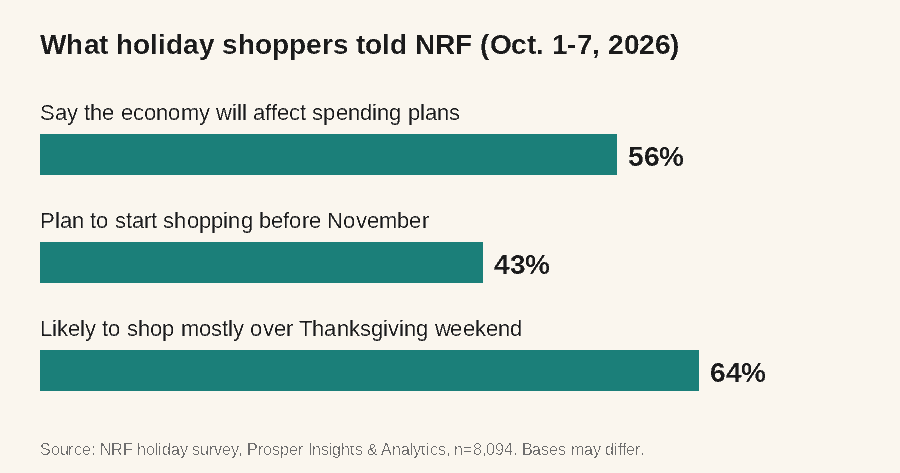
Among the 56% who expect the economy to affect their plans, NRF reports that 43% plan to shop sales more often, 31% will compare prices online more often and 29% will use coupons more often. Of the shoppers who start before November, 50% say they do it to spread out their budgets. That last number is the most useful for a household plan: buying a little at a time is a budgeting tool, not only a way to catch deals.
What the releases do not give us is a per-person spending figure, so this article does not quote one. Your holiday budget should come from your own income, savings and obligations, not from a national average.
Step 1: Define what counts toward your holiday budget
Many people set a gift number and then discover that the season cost far more. The gap usually comes from costs that never made it onto the list. Decide now what your holiday budget includes, and write it down so you can compare it with your bank and card statements in January.
- Gifts for family, friends, coworkers, teachers and anyone else you buy for.
- Food and hosting: the holiday meal, party supplies, drinks, and any extra groceries for guests.
- Travel: gas, flights, rental cars, lodging, pet boarding and tolls.
- Decor and cards: lights, a tree, wrapping paper, cards and postage.
- Events and giving: school or office events, charity donations, tips for service providers.
- A buffer for the purchase you did not plan, because there is always one.
In the 50/30/20 framework we cover in our 50/30/20 budgeting guide, most holiday spending belongs in the “wants” bucket, although some travel or food costs may overlap with needs. Seeing it that way makes the trade-off visible: every dollar added to the holiday budget is a dollar not available for savings or debt payoff unless you reduce something else.
Step 2: Choose a total you can afford
There is no single right amount. Three methods can help you find a number, and it is worth comparing them before you commit.
Method A: Start from last year. Add up what you actually spent in November, December and early January last year using bank and card statements. Memory can undercount. If last year caused stress or debt, set this year’s holiday budget below it.
Method B: Start from your wants bucket. If you already budget monthly, take the amount you can comfortably redirect from your wants category over the next two months. For example, a household with $4,600 of monthly take-home pay and a 30% wants bucket has $1,380 a month for all wants. If $400 a month of that can go to the holidays for two months, the holiday budget is $800.
Method C: Start from cash on hand. Subtract your emergency fund, rent or mortgage, bills and minimum debt payments from what you will earn between now and December 25. Whatever remains is the ceiling, and your holiday budget should sit comfortably under it.
Whichever method you use, a good test is to ask whether you could pay the full amount from your checking or savings account without missing a bill. If not, the holiday budget is too high for this year or the timeline is too short. If your cash is the limiting factor, our guide to high-yield savings accounts and CDs explains where to hold money you need within a few weeks, and why you should not lock it away in the meantime.
The rest of this guide uses a hypothetical $800 holiday budget so the arithmetic is easy to follow. Replace each figure with your own holiday budget numbers.
Step 3: Split the total into categories
A single lump-sum holiday budget is hard to follow because nothing tells you when to stop. Categories give each purchase a home. Here is one way to divide the example $800.
| Category | Amount | Share of holiday budget |
|---|---|---|
| Gifts | $400 | 50% |
| Food and hosting | $150 | 18.75% |
| Travel | $120 | 15% |
| Decor, cards and postage | $50 | 6.25% |
| Giving and tips | $30 | 3.75% |
| Buffer | $50 | 6.25% |
| Total | $800 | 100% |
These shares are only an example. A household that travels will put far more into the travel line and less into gifts. A household hosting a large meal may reverse the proportions. What matters is that the lines add up to the total, so that raising one line means lowering another.
Step 4: Set a limit for each person
The gifts line is where a holiday budget most often fails, because each purchase feels small. List everyone you plan to buy for and give each person a limit before you browse. In the example, $400 for gifts is divided like this:
| Recipient | Limit |
|---|---|
| Partner | $90 |
| Two children ($60 each) | $120 |
| Two parents ($40 each) | $80 |
| Sibling | $30 |
| Two friends ($20 each) | $40 |
| Teacher | $20 |
| Planned total | $380 |
| Unassigned | $20 |
Leaving a small unassigned amount in the gifts line is deliberate. It absorbs shipping fees, a last-minute exchange or a surprise guest without touching the rest of the plan.
If the list is longer than the money allows, you have three honest options: lower the per-person limits, shorten the list, or change the format. Many families agree on a single gift exchange, a draw-a-name system, or a rule that adults give only to children. Those conversations are easier in October than in the week before the holiday. Because gift cards topped the wish list in NRF’s survey, a fixed-value gift card can also be a useful way to give within a limit, as long as you buy it from a source you trust and keep the receipt.
Step 5: Fund the holiday budget week by week
Once you have a holiday budget total, convert it to a weekly amount. Today is October 23, 2026, and Christmas falls on Friday, December 25, which is exactly nine weeks away. The later you start saving, the larger each weekly transfer becomes.
| Start date | Weeks until December 25 | Weekly amount to reach $800 |
|---|---|---|
| Friday, October 23 | 9 | $88.89 |
| Friday, November 6 | 7 | $114.29 |
| Friday, November 20 | 5 | $160.00 |
| Friday, December 4 | 3 | $266.67 |
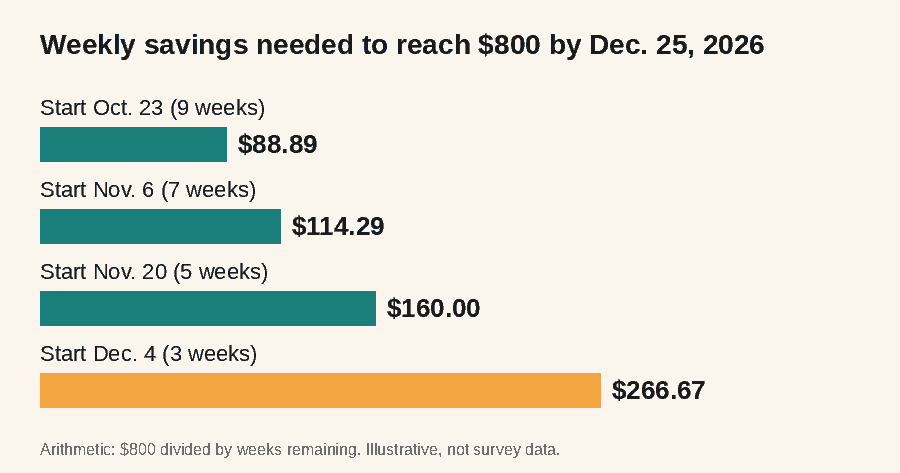
If your paycheck is biweekly or semi-monthly, divide the total by the number of paychecks left before the holiday instead. For $800 and four remaining paychecks, that is $200 per paycheck. Set up an automatic transfer on payday into a separate savings account or a labeled sub-account so the money is not mixed with everyday spending. Moving the money first and spending what remains is the same “pay yourself first” habit that makes any budget easier.
If the weekly number looks too high, that is useful information. It means your holiday budget is probably too large for the time you have left. Lower the total now rather than make up the difference with a credit card in December.
Step 6: Decide how you will pay
The same $800 can cost very different amounts depending on how you pay for it. The right choice depends on whether you can pay in full by the due date.
| Payment method | Works well when | Watch out for |
|---|---|---|
| Cash or debit card from the holiday savings account | You saved ahead and want a hard stop | Overdraft fees if the balance runs out; less fraud protection than some credit products |
| Credit card paid in full before the due date | You earn rewards and will not carry a balance | Rewards are not worth interest; the statement arrives in January |
| Credit card with a balance carried over | Rarely a first choice | Interest on the unpaid balance |
| Buy now, pay later (BNPL) plans | The schedule fits your cash flow and you can track every plan | Several small plans can overlap and are easy to lose track of |
| Store card with a discount at checkout | You will use the card for a purchase you were already planning and pay it off | A deal that tempts you to spend more than planned |
To see why carrying a balance matters, consider the example $800. Suppose all of it goes on a card with a hypothetical 24% annual interest rate, which is 2% per month, and you pay $100 each month. It takes nine payments to clear the balance, and the interest adds up to about $80.61. That is roughly 10% on top of what you spent, for gifts that were gone in December.
The rate here is an assumption chosen for easy math, not a current market average, so check the APR on your own card.
If you already carry a balance and want to understand how the lenders and issuers are doing, our look at credit card delinquency rates in 2026 covers the broader picture, and our guide to how credit card rewards work shows why a rewards rate rarely outweighs interest.
If you choose credit, a few habits help. Put your holiday budget on a single card so the total is easy to see. Keep a running tally in a notes app or spreadsheet. Pay the card down weekly instead of waiting for the statement, which keeps the balance close to the cash you set aside. With BNPL, write every plan and due date in one list, and count the full price of each purchase against the holiday budget on the day you agree to it, not when payments come due.
A shopping calendar for November and December 2026
Dates drive impulse spending. A short calendar lets you decide in advance when you will shop and what you will buy.
| Date | What happens | Budget action |
|---|---|---|
| Now through October 31 | 43% of shoppers plan to start before November, per NRF | Finish your list, limits and categories; start weekly transfers |
| November 1 | NRF defines the holiday season as November 1 through December 31 | Buy early items if you have the cash and have compared prices |
| Thursday, November 26 | Thanksgiving | Buy only items already on your list |
| Friday, November 27 | Black Friday | Take your list, not an open mind |
| Monday, November 30 | Cyber Monday | Check the total against your gift line before you check out |
| Early to mid-December | Shipping deadlines approach | Order remaining gifts; keep the buffer for shipping fees |
| Friday, December 25 | Christmas Day | Record any final spending |
| Early January | Statements arrive | Compare actual spending to your plan |
NRF reports that 64% of shoppers are likely to do most of their shopping over Thanksgiving weekend. A weekend of heavy promotion is where a prepared holiday budget and list pay off most. Before you buy, check the return policy and the last day for returns, because many holiday purchases are made weeks before the gift is opened.
Mistakes that break a holiday budget
- Setting a total without categories. Without lines, nothing tells you when a category is full.
- Counting only gifts. Travel, food and hosting often cost as much as presents.
- Treating a discount as a saving. A 30% markdown on something you did not plan to buy is still a 100% spend.
- Letting several small BNPL plans overlap. Individually manageable payments can crowd your January budget.
- Skipping the buffer. Shipping, wrapping, replacement batteries and surprise guests are predictable. Their exact amount is not.
- Using the emergency fund by default. A holiday is not an emergency, and replenishing the fund takes months.
- Shopping without a list. Promotional emails and social posts are designed to move you off your list.
- Ignoring January. Charges made in December are paid in January, alongside heating bills and any annual fees.
If you already overspent
If your holiday budget is already blown, the goal now is to limit the damage rather than to feel guilty about it. Pause new purchases, total what you have spent so far, and compare it with your plan. Decide which unpaid items can be cancelled or returned to bring the holiday budget back in line. Then pay down the highest-interest balance first with whatever you can free up, and put the rest into the January budget as a temporary line item with an end date.
If the balance is large, compare the cost of carrying it with the cost of moving it. Our guide to the best balance transfer credit cards of 2026 explains how introductory offers and fees work, and why the transfer fee and the length of the promotional period matter as much as the headline rate. A transfer only helps if you can pay off the balance before the offer ends. For the broader picture, our personal finance guide for 2026 places holiday spending in the context of an annual plan, and our budget calculator can show how a temporary holiday line changes your monthly numbers.
Frequently asked questions
How much should I spend on a holiday budget?
There is no universal figure. Start from what you spent last year, what you can redirect from your wants category, and what cash you will have after bills and savings. A good holiday budget is one you could pay in full from your accounts without missing a bill.
When should I start saving for the holidays?
As early as you can. For Christmas 2026, starting on October 23 means nine weekly transfers. Starting in early December means the same total is squeezed into three weeks, which triples the weekly amount in our $800 example. Many people also open a dedicated holiday budget savings account each January and contribute monthly.
Is it better to use cash, debit or credit for holiday shopping?
It depends on whether you pay in full. Cash or debit from a holiday savings account creates a hard stop. A credit card can work if you pay the balance before the due date, but a carried balance can erase any rewards and add interest.
Should gift cards count toward my holiday budget?
Yes. A gift card is cash you have spent. Count its full face value against the person’s limit on the day you buy it, and keep the receipt.
What if my holiday budget is much smaller than last year’s?
Say so early. Agreeing on a smaller gift exchange, a spending cap or homemade gifts lets everyone plan together, and an agreed plan is easier on everyone than an unplanned card balance in January.
Sources reviewed (checked October 23, 2026)
- NRF, “NRF Forecasts 2026 Holiday Sales Growth as Consumers Remain Resilient” (primary industry source; published October 15, 2026; 4.2% growth forecast, $1.013 trillion, 2025 comparison, and definition of the season as November 1 to December 31)
- NRF, “Affordability Shapes Winter Holiday Shopping, According to NRF Holiday Survey” (published October 20, 2026; Prosper Insights & Analytics survey of 8,094 adults, October 1 to 7, margin of error plus or minus 1.1 points)
- Arithmetic in this article (weekly savings amounts, category splits and the credit card interest example) was calculated by the FinovativeHub editorial team and checked with a script. The 24% APR is a hypothetical assumption, not a market statistic.
Limitation: we attempted to review federal consumer-protection guidance on gift card scams, buy now pay later products and current credit card interest rates, but those pages could not be opened during this review. The article therefore makes no specific claims from those sources. Check current card terms and any BNPL agreement directly with the issuer or provider.
Disclaimer: This article is for general education and is not financial, tax or legal advice. Spending plans depend on your income, debts and goals. Confirm current terms with your card issuer, lender or a qualified professional.

FinovativeHub Editorial Team publishes personal finance guides for American readers, covering budgeting, credit cards, loans, and retirement accounts. We aim to explain how things work in plain English and to cite official sources, such as the IRS, where they apply. Rates, fees, and limits change, so confirm current terms with the provider or agency before you act.