Quick answer: The FSA deadline 2026 enrollees should watch is the end of your plan year, which for most people with a calendar-year plan is December 31, 2026. Under IRS rules, a health flexible spending account (FSA) is generally a "use-it-or-lose-it" account: money you elected and did not spend can be forfeited. Your employer may soften that with either a carryover (up to $680 of unused 2026 money moving into 2027) or a grace period (up to 2½ months, which is March 15 for a calendar-year plan), but a plan cannot offer both. The 2026 salary-reduction limit is $3,400.
Those are the headline rules. What matters for your wallet is which version your employer chose, when your plan year actually ends, how long you have to file claims, and which purchases still qualify. This guide walks through each of those steps with worked examples, a list of expenses to check before the year ends, and a simple method for choosing your 2027 election so you are not scrambling again next October. It is general education, not tax or benefits advice, and your plan documents control.
What this guide covers
- FSA deadline 2026: the numbers at a glance
- How the use-it-or-lose-it rule works
- Carryover vs. grace period: which one does your plan have?
- What forfeiture looks like: three plans, one $900 balance
- Five steps to take before the FSA deadline
- What you can still spend FSA money on
- What generally does not qualify
- What an FSA is worth in tax terms
- How to choose your 2027 election
- FSA and HSA: how they interact
- Common mistakes
- FAQ
- Sources reviewed
FSA deadline 2026: the numbers at a glance
The IRS adjusts the health FSA limit for inflation each year. The most recent figures we could confirm are below, with the 2025 amounts for comparison.
| Item | 2025 plan year | 2026 plan year |
|---|---|---|
| Health FSA salary-reduction limit (per employee, per employer plan) | $3,300 | $3,400 |
| Maximum carryover a plan may allow into the next year | $660 | $680 |
| Maximum grace period (alternative to carryover) | 2½ months | 2½ months |
| Dependent care FSA limit (a separate account) | Not covered here | Reported as $7,500 ($3,750 if married filing separately); see note below |
The 2025 figures come straight from IRS Publication 969. The 2026 figures come from IRS Revenue Procedure 2025-32. We could not open the IRS document during our review, so we confirmed the $3,400 and $680 amounts from three separate benefits-industry summaries that cite it (see Sources reviewed). The dependent care figure is from one secondary source and is not confirmed against an IRS page, so check it in your plan materials before relying on it.
As of October 22, 2026, we found no official IRS announcement of the 2027 health FSA limit. Several websites publish projections, but a projection is not a rule. Your employer’s open-enrollment materials will show the number that applies to you.
How the use-it-or-lose-it rule works
A health FSA lets you direct part of your pay, before income tax, into an account your employer sponsors. You then use that money to pay for qualified medical costs. IRS Publication 969 puts the basic rule plainly: FSAs are generally "use-it-or-lose-it" plans. Unused money beyond what the plan allows you to keep is forfeited, and the employer is not permitted to refund the balance to you.
Three terms decide whether you lose money:
- Plan year. The 12-month period the FSA runs. Many employers use the calendar year, but some use a fiscal year that starts in, say, July or October. Your deadline is the end of your plan year, not necessarily December 31.
- Services date. Plans generally reimburse an expense based on when the care was provided, not when you paid or received a bill. A dentist visit in November that you pay for in January normally belongs to the 2026 plan year.
- Claims run-out period. The window after the plan year ends in which you can still submit receipts for expenses incurred during the plan year. Publication 969 does not set a run-out period, so it is a plan rule and varies. Ask your administrator for the exact last day to submit claims, because it is a separate date from the last day to receive care.
Another feature surprises people: with most health FSAs, the full amount you elected for the year is available to spend from the first day of the plan year, even though your paychecks fund it gradually. That helps if you need an expensive item early in the year. Your plan documents describe how a job change is handled.
Carryover vs. grace period: which one does your plan have?
Employers may add one of two rules that reduce forfeitures. They cannot add both. Publication 969 states that a plan adopting a carryover provision is not permitted to also provide a grace period for a health FSA (it cites IRS Notice 2013-71). Some plans offer neither, and neither is required.
| Carryover | Grace period | |
|---|---|---|
| What it does | Lets unused money move into the next plan year to pay for new expenses | Extends the time to incur new expenses against the old year’s money |
| Maximum | $680 for money left at the end of the 2026 plan year | Up to 2½ months after the plan year ends (March 15, 2027 for a calendar-year plan) |
| Amount over the limit | Forfeited | Anything unspent when the grace period ends is forfeited |
| Employer choice | The plan may set a lower maximum than the IRS cap | The plan may offer a shorter period |
| Where to find it | Summary plan description or enrollment guide | Summary plan description or enrollment guide |
One practical difference: a carryover cushions only a limited amount (up to $680), but it applies however large your balance. A grace period has no dollar cap, but it only helps if you can really use the money on eligible expenses within the extra weeks. If your balance is large and your plan has only a carryover, the part above the cap is the part to spend first.
What forfeiture looks like: three plans, one $900 balance
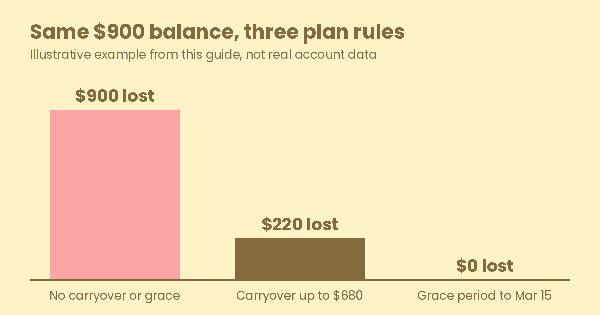
Suppose three coworkers each elected $2,400 for 2026, spent $1,500, and have $900 left on December 31. The only difference is how their plans are written.
| Plan type | What happens to the $900 | Money forfeited if nothing more is spent |
|---|---|---|
| No carryover, no grace period | All $900 is forfeited on December 31 | $900 |
| Carryover of up to $680 | $680 moves into 2027; the other $220 is forfeited | $220 |
| Grace period through March 15, 2027 | The $900 can pay for expenses incurred January 1 through March 15, 2027 | $0 if used by then; otherwise whatever remains |
Forfeiting is not a total loss in tax terms, because you did not pay income tax on the money that went in. As an illustration only, assume a 22% federal marginal rate and the 7.65% payroll tax that most employees below the Social Security wage base do not pay on FSA contributions. On $900 of forfeited money, those tax savings come to about $267, so the net cost of the loss is roughly $633 in take-home pay. That is a large enough amount to be worth a few phone calls.
Five steps to take before the FSA deadline
- Find your plan year end. Look in your benefits portal or plan summary. If your plan year is not the calendar year, your true deadline is different from December 31.
- Check your balance. Log in to your FSA administrator’s site and note the available balance, not just what you have contributed so far. Also note whether the site shows claims still pending.
- Identify which rule you have. Search the plan summary for the words "carryover" and "grace period." If you see neither, assume forfeiture on the last day.
- Write down two dates. The last day to receive care or buy items, and the last day to submit claims. Put both on your calendar.
- Match your balance to real needs. Use the lists below to schedule appointments and buy eligible items you were going to need anyway. Do not spend money on things you do not need just to empty the account.
What you can still spend FSA money on
The IRS describes qualified medical expenses as costs specified in your plan that would generally qualify for the medical and dental expense deduction. Publication 969 also confirms that over-the-counter medicines qualify whether or not a doctor prescribed them, and so do menstrual care products. Beyond you, the account can generally cover your spouse, your claimed dependents, and your child who is under age 27 at the end of your tax year.
Typical categories to check against your plan’s eligible-expense list, and the timing trap in each:
| Category | Examples | Timing note |
|---|---|---|
| Vision | Eye exam, prescription glasses, contact lenses, contact lens solution | Buy and take delivery before the deadline; a prepaid order shipped in January may fall into the next year |
| Dental and orthodontic | Cleanings, fillings, copays and your share of the cost after insurance, braces payments | Care must be provided in the plan year; paying a future treatment in advance generally does not count |
| Prescriptions and copays | Medication costs, doctor and specialist copays, deductibles | Date of service usually governs, so a late-December visit counts for 2026 even if the bill arrives later |
| Over-the-counter items | Pain relievers, allergy and cold medicine, first-aid supplies, menstrual care products | Plans differ on whether the purchase date or use date matters; buy only what you will use in a reasonable time |
| Hearing and mobility | Hearing aids and batteries, crutches, braces | Check whether the item needs a letter of medical necessity under your plan |
| Therapy and screenings | Physical therapy, mental health counseling visits, lab work not covered by insurance | Appointments book up in December, so schedule early |
Two cautions. First, administrators sometimes require itemized receipts or an explanation of benefits to prove the expense is medical, so keep both. Second, an FSA debit card swipe is not proof by itself; the administrator may later ask for documentation and can require you to repay or substantiate a charge. Keep records until your plan year is closed out.
What generally does not qualify
Publication 969 lists the main exclusions. Health FSA money generally cannot pay for:
- Health insurance premiums, including premiums you pay through your employer or on your own.
- Long-term care expenses.
- Amounts covered by another health plan. If insurance already paid a bill, you cannot also be reimbursed from the FSA for that part.
General wellness spending, such as a gym membership, cosmetic products or vitamins you take for general health, usually does not qualify unless a plan-approved exception applies. When in doubt, ask the administrator before you buy, and do not rely on a retailer’s "FSA eligible" label alone.
What an FSA is worth in tax terms
An FSA is most valuable when you spend everything you elect on care you were already going to buy. As an illustration, suppose someone elects the full 2026 limit of $3,400, is in the 22% federal bracket, and does not pay state income tax. Contributions are subtracted from taxable wages for income tax and, for most employees, for payroll tax as well.
| Tax effect on $3,400 | Rate | Approximate savings |
|---|---|---|
| Federal income tax | 22% | $748.00 |
| Social Security and Medicare payroll tax | 7.65% | $260.10 |
| Total | 29.65% | $1,008.10 |
These numbers are an illustration, not a prediction. Your marginal bracket may be lower or higher, state rules vary, and payroll tax treatment depends on your income and employer. Our guide to 2026 federal tax brackets and the standard deduction explains how to find your marginal rate. The savings only materialize if the money is spent on qualified expenses: if $900 is forfeited, as in the example above, that part of the benefit is gone.
How to choose your 2027 election
Open enrollment is when most employers ask you to pick a 2027 amount, and the choice usually stays fixed for the year unless you have a qualifying life event, such as a change in family status. The easiest way to avoid forfeiture next year is to elect only what you can name.
Here is the method, followed by an example using invented numbers:
- List expenses you are confident about, based on your last twelve months of receipts.
- Add any known events, such as scheduled dental work, a new prescription, or a child’s braces.
- Subtract what you expect insurance to pay. Use only your share.
- Elect that total or slightly less, and do not round up to the maximum out of habit.
- Divide the total by your number of paychecks to see the per-paycheck amount.
| Expected 2027 cost (example) | Your share |
|---|---|
| Prescriptions (monthly copays) | $480 |
| Dental cleanings and one filling, after insurance | $350 |
| Eye exam and one pair of glasses | $400 |
| Contact lenses and solution | $250 |
| Doctor and urgent care copays | $300 |
| Over-the-counter medicine and first-aid supplies | $120 |
| Estimated total | $1,900 |
In this example, a $1,900 election works out to about $73.08 per paycheck on 26 paychecks or $79.17 on 24. Electing the $3,400 maximum instead would only make sense if the person had other costs to cover, because it would invite roughly $1,500 of forfeiture risk. If you are unsure, electing a bit under your estimate and paying the rest out of pocket is safer than electing more than you will use. Your emergency savings can fill the gap, and our budget calculator can show how a per-paycheck election fits your monthly budget. Our 50/30/20 budgeting guide is one way to find room for it, and our comparison of high-yield savings and CDs covers where to keep that cash.
FSA and HSA: how they interact
A health savings account (HSA) and a general-purpose health FSA are different tools. An HSA belongs to you and its balance generally stays in the account from year to year; an FSA belongs to your employer’s plan and is generally use-it-or-lose-it. Publication 969 says that a limited-purpose health FSA, which pays only certain items such as dental and vision care, can be paired with an HSA, and that it can pay for preventive care before the deductible is met. A general-purpose health FSA, including one through a spouse’s employer that covers you, can make you ineligible to contribute to an HSA. If you are considering switching plans at open enrollment, confirm in writing which kind of FSA your employer offers before you decide. Pre-tax FSA money is one year-end lever among several; our guide to 2026 401(k) and IRA contribution limits covers the retirement side, and our personal finance overview shows how these choices fit together.
Common mistakes
- Assuming everyone’s deadline is December 31. Some plans run on a fiscal year, and run-out dates differ.
- Assuming carryover and grace period both apply. A plan can have only one.
- Confusing the carryover cap with your balance. Only the first $680 (or less, if your plan caps it lower) moves forward; the rest is forfeited.
- Prepaying for next year’s care. Reimbursement generally depends on when the care is provided.
- Buying things you do not need. Spending $100 you would not otherwise spend to save $100 of forfeiture is a loss, not a win.
- Skipping paperwork. Missing receipts are one of the most common reasons claims are denied.
- Forgetting the claim deadline. The last day to submit receipts can be earlier than people expect.
- Electing the maximum by default. The limit is a ceiling, not a target.
Frequently asked questions
What is the FSA deadline for 2026?
For a calendar-year plan, the deadline to incur eligible expenses is December 31, 2026, unless the plan has a grace period (up to March 15, 2027). Plans on a different fiscal year have a different date, and the last day to submit claims can fall after the plan year ends.
How much FSA money can I carry over from 2026 to 2027?
If your employer chose the carryover option, up to $680 of unused 2026 funds can move forward, according to IRS Revenue Procedure 2025-32 as summarized by benefits advisers. Employers can set a lower cap, and a plan with a carryover cannot also offer a grace period.
Does my employer have to offer a carryover or a grace period?
No. Both are optional. If your plan offers neither, unused health FSA money is generally forfeited at the end of the plan year.
What happens to my FSA if I leave my job?
The treatment depends on your plan documents. In general, participation ends when you leave, and the plan sets rules for which expenses are covered and for how long afterward. Ask your administrator for the termination rules before your last day.
Can I use my FSA for my spouse or children?
Yes, for qualified medical expenses. Publication 969 says covered people include you, your spouse, your claimed dependents and your child who is under 27 at the end of your tax year.
Can I change my 2027 FSA amount during the year?
Usually not, except after a qualifying event such as a change in marital status or family size. The details are in your plan documents.
Sources reviewed (checked October 22, 2026)
- IRS Publication 969, Health Savings Accounts and Other Tax-Favored Health Plans (primary; the page reviewed is the 2025 edition and states the 2025 health FSA limit of $3,300 and carryover of $660, the use-it-or-lose-it rule, the 2½-month grace period, the carryover-or-grace-period restriction, eligible and ineligible expenses, and covered family members)
- IRS Revenue Procedure 2025-32, 2026 inflation adjustments (primary; the IRS document could not be opened during this review, so the 2026 figures were confirmed from the three summaries below)
- Hylant, IRS releases health FSA limits for 2026 (secondary; October 16, 2025; $3,400 limit and $680 carryover)
- IMA, 2026 health FSA and qualified transportation limits (secondary; October 13, 2025; $3,400 limit and $680 carryover)
- EPIC Insurance Brokers, 2026 FSA limits released (secondary; October 10, 2025; $3,400, $680, and the reported $7,500 dependent care limit, which we did not confirm against an IRS page)
- IRS Notice 2013-71, carryover and grace period restriction (primary; referenced in Publication 969 and not opened separately)
Plan-specific rules such as run-out periods, mid-year election changes, termination treatment, and receipt requirements vary by employer, so they are described here as general practice and should be confirmed in your plan documents.
Disclaimer: This article is for general education and is not tax, benefits, legal or medical advice. Limits, plan rules and state laws change. Confirm current terms with the IRS, your plan administrator or a qualified professional.

FinovativeHub Editorial Team publishes personal finance guides for American readers, covering budgeting, credit cards, loans, and retirement accounts. We aim to explain how things work in plain English and to cite official sources, such as the IRS, where they apply. Rates, fees, and limits change, so confirm current terms with the provider or agency before you act.