Last Updated: October 23, 2026 (student debt balances re-checked against the New York Fed’s August 11, 2026 report; repayment-plan rules, loan limits and legal dates were not re-verified on this date, so confirm them at StudentAid.gov) | Reviewed by: FinovativeHub Editorial Team | Sources: Key figures are linked to official sources (StudentAid.gov, ED, NY Fed) in the text

Editorial Policy
We do not accept payment from lenders, loan servicers, or the Department of Education to influence this content. Where we link to a lender or product, we disclose it. Our goal is accuracy first — including telling you when a rule is unsettled or still being litigated, rather than presenting it as more final than it is. This article is reviewed and updated as federal guidance changes.
Financial Disclaimer
This article is for general educational purposes and does not constitute individualized financial, tax, or legal advice. Student loan rules are complex and change over time; verify your specific situation with your loan servicer, StudentAid.gov, or a qualified financial or tax professional before making repayment decisions.
If you owe federal student loans, the rules changed under your feet this summer. On July 1, 2026, the Department of Education replaced the old menu of income-driven repayment plans with two new options — the Repayment Assistance Plan (RAP) and the Tiered Standard Plan — and started winding down the SAVE plan for good. If you haven’t logged into StudentAid.gov since last year, some of what you think you know about your repayment options is now out of date.
This guide walks through exactly what changed, why, who it affects, what the real numbers say about U.S. student debt right now, and — most importantly — which option actually makes sense for your income, your balance, and your goals. No jargon dumps, no scare tactics. Just the mechanics, real payment examples, real borrower scenarios, and a clear decision path.
Quick Answer
Starting July 1, 2026, new federal Direct Loan borrowers (and anyone who takes out a new loan or consolidates existing loans after that date) can only choose between two repayment plans: the Repayment Assistance Plan (RAP), which sets your payment at 1%–10% of your income with forgiveness after 30 years, and the Tiered Standard Plan, a fixed payment over 10 to 25 years based on your loan balance with no forgiveness. The SAVE plan has been ruled unlawful and is being phased out; borrowers still on it will get a notice and a 90-day window to switch. If you only have loans from before July 1, 2026 and don’t borrow anything new, you generally keep your current plan for now.
Key Takeaways
- Two plans replace several: RAP and the Tiered Standard Plan are now the only options for new Direct Loan borrowers after July 1, 2026. PAYE, ICR, and SAVE are closed to new enrollment or being eliminated.
- RAP is income-based: Payments run 1%–10% of your adjusted gross income (AGI), with a $50/month reduction per dependent and a $10/month floor. Unpaid interest is waived when you make your on-time payment, so your balance can’t balloon.
- Tiered Standard is balance-based: Your fixed monthly payment and repayment term (10, 15, 20, or 25 years) depend on how much you owe — not your income.
- Only RAP counts toward PSLF. The Tiered Standard Plan does not qualify for Public Service Loan Forgiveness.
- Forgiveness under RAP is taxable as ordinary income after 30 years, unless it comes through PSLF, which stays tax-free.
- Grad PLUS loans are gone for new borrowers as of July 1, 2026, replaced by lower annual and lifetime borrowing caps.
- About $1.65 trillion in U.S. student loan debt was outstanding in Q2 2026 (per NY Fed, Source, checked Oct. 23, 2026) — this overhaul is one of the largest changes to federal repayment in a generation.
- If you’re not actively taking new loans, you generally don’t have to do anything right now — except get off SAVE if you’re still on it.
Key 2026 Student Loan Statistics
(Figures below are from the Federal Reserve Bank of New York’s Household Debt and Credit Report; they change quarterly.)
| Total U.S. student loan debt (NY Fed, credit-report data) | $1.66 trillion (Q1 2026); $1.65 trillion (Q2 2026) | Per NY Fed, Source |
| Student loan balances newly 90+ days delinquent (annualized flow) | 7.83% in Q2 2026 (12.88% a year earlier) | Per NY Fed, Source, checked Oct. 23, 2026. The NY Fed cautions that comparisons across periods are distorted by the re-reporting of defaulted debt. |
Why these numbers matter for you: the RAP-vs-Tiered-Standard decision in this guide applies to most federal borrowers directly. If your balance is large — common among graduate and professional degree holders — the new Grad PLUS caps and the 25-year Tiered Standard term (or RAP’s 30-year timeline) become especially relevant, since they’re specifically designed around exactly this kind of high-balance borrower.
Table of Contents
- What Actually Changed on July 1, 2026
- Why the Repayment System Changed
- Who Is Affected — And Who Isn’t
- The Repayment Assistance Plan (RAP), Explained
- The Tiered Standard Plan, Explained
- RAP vs. Tiered Standard: Side-by-Side Comparison
- RAP vs. SAVE: What Actually Changed for Borrowers
- RAP vs. the Old IBR and PAYE Plans
- What Happened to SAVE, PAYE, IBR, and ICR
- Old System vs. New System: The Complete Overview
- Monthly Payment Examples by Income and Balance
- Public Service Loan Forgiveness (PSLF) Under the New Rules
- Grad PLUS Elimination and New Borrowing Caps
- Undergraduate vs. Graduate Borrowers: What Changes for Each
- Parent PLUS Loans: What Changed for Parents
- Federal vs. Private Student Loans in 2026
- RAP vs. Refinancing Into a Private Loan
- Tax Implications of Loan Forgiveness
- Pros and Cons of Each Plan
- Real Borrower Scenarios
- Common Myths vs. Facts
- Common Mistakes to Avoid
- Hidden and Advanced Repayment Strategies
- How to Choose the Right Plan for You
- Interactive Tools to Use Before You Decide
- Timeline of Key Deadlines
- Expert Tips
- Future Outlook and Latest Legal Developments
- Frequently Asked Questions
- Final Summary and Action Steps
1. What Actually Changed on July 1, 2026
For nearly two decades, federal student loan borrowers picked from a confusing lineup: Standard, Graduated, Extended, and four separate income-driven plans (IBR, PAYE, ICR, and SAVE), each with its own formula, eligibility rules, and forgiveness timeline. That lineup effectively ended on July 1, 2026.
Under the law that created these changes — the reconciliation bill signed in July 2025, referred to in official communications as the Working Families Tax Cuts Act and elsewhere as the One Big Beautiful Bill Act (OBBBA) — any borrower who takes out a new federal Direct Loan on or after July 1, 2026, or who consolidates an existing loan after that date, is limited to exactly two repayment options:
- The Repayment Assistance Plan (RAP) — a new income-driven plan
- The Tiered Standard Plan — a new fixed-payment plan with a term based on your balance
There’s an important nuance here that trips a lot of people up: mixing old and new loans can limit your options. Official guidance is not fully uniform on this point. StudentAid.gov says that “if you have a mix of loan types and disbursement dates, your loans may be eligible to be repaid under two different IDR plans” (per ED, Source), while some servicer guidance describes RAP as the only income-driven plan available once you have at least one loan first disbursed on or after July 1, 2026. Before borrowing again or consolidating, confirm with your loan servicer which plans your older loans will remain eligible for. For other kinds of debt, our guide to debt consolidation loans compares personal loan options.
At the same time, the SAVE plan — which had been blocked in court and never fully implemented for most borrowers — is being formally wound down. Loan servicers began notifying SAVE enrollees in mid-2026 that they have roughly 90 days to pick a new plan, or they’ll be automatically moved into the Standard Repayment Plan or the new Tiered Standard Plan.
2. Why the Repayment Plans Changed
Three forces converged to produce this overhaul:
1. Litigation had already broken the old system. The SAVE plan was challenged in federal court, and portions of it were blocked before it was ever fully rolled out. Millions of borrowers spent 2024–2025 in an interest-free forbearance limbo while the case worked through the courts — not officially in repayment, not officially forgiven, just paused. That was never sustainable.
2. Lawmakers wanted a simpler, more predictable system. The Department of Education has described the goal as replacing “a fragmented and confusing array” of plans with two straightforward choices — one based on income, one based on balance — so borrowers don’t need a financial advisor to understand their options.
3. Cost control. The new rules are also projected to reduce federal spending on income-driven repayment and loan forgiveness by hundreds of billions of dollars over ten years, primarily by extending RAP’s forgiveness timeline to 30 years (versus 20–25 years under the old plans), tightening graduate borrowing caps, and eliminating some of the more generous provisions in SAVE.
3. Who Is Affected — And Who Isn’t
This is the single most important section for figuring out whether you need to act right now.
You’re directly affected if:
- You’re a new borrower taking out your first federal student loan on or after July 1, 2026
- You already have federal loans and plan to borrow more (for a new semester, a second degree, etc.) on or after that date.
- You’re planning to consolidate existing loans after July 1, 2026
- You were enrolled in the SAVE plan.
- You’re a graduate or professional student who was planning to use Grad PLUS loans.
- You’re a Parent PLUS borrower.
You’re not immediately affected — for now — if:
- All of your federal loans were disbursed before July 1, 2026
- You don’t plan to borrow any new federal loans or consolidate.
- You’re currently on Standard, Graduated, Extended, or IBR and want to stay there.
That second group keeps access to their current plan under what the Department of Education calls “legacy” treatment. But it’s worth watching this space — legacy protections in federal programs have shifted before, and it’s realistic to expect further guidance and possibly further legal challenges over the next 12–24 months.
4. The Repayment Assistance Plan (RAP), Explained
RAP is the only income-driven repayment plan available to new Direct Loan borrowers after July 1, 2026. Here’s how the math actually works.
Quick definition box: RAP (Repayment Assistance Plan) is a federal income-driven student loan repayment plan, effective July 1, 2026, that sets your monthly payment as a percentage (1%–10%) of your adjusted gross income and forgives any remaining balance after 30 years of qualifying payments.
The formula, step by step:
- Start with your Adjusted Gross Income (AGI) from your most recent tax return — the number on Line 11 of Form 1040.
- Apply a tiered percentage based on your income bracket. The rate scales in roughly 1-percentage-point steps as income rises, running from about 1% of AGI at the low end up to a 10% cap at the top of the scale (generally around $100,000+ AGI). Borrowers with AGI at or below roughly $10,000 pay a flat $10 per month.
- Divide that annual figure by 12 to get your base monthly payment.
- Subtract $50 for every dependent you claim on your federal tax return.
- Your payment can never go below the $10/month floor.
Two built-in protections make RAP different from older IDR plans:
- Interest subsidy: If your monthly payment doesn’t cover the interest that accrued that month, the government waives the difference instead of adding it to your balance. In practice, this means your loan balance can’t grow the way it could under some older plans, even if your payment is very small.
- Minimum principal guarantee: If your payment doesn’t reduce your principal balance by at least $50 a month, the Department of Education kicks in the difference so your principal keeps declining.
Forgiveness: Any remaining balance is forgiven after 360 qualifying monthly payments — 30 years — longer than the 20–25 years typical of the old IDR plans. Forgiveness under RAP is generally treated as taxable income, except when it comes through PSLF (see Section 12).
A quirk worth knowing: RAP still allows married borrowers to file taxes as Married Filing Separately to exclude a spouse’s income from the RAP payment calculation — a detail that survived from an earlier, more borrower-friendly version of the bill. If you’re married and considering this, run it by a tax professional first, since filing separately carries other tax tradeoffs.
Who can use RAP: Direct Subsidized and Unsubsidized Loans, Direct PLUS Loans for graduate or professional students, and Direct Consolidation Loans that don’t include an underlying Parent PLUS loan. Parent PLUS loans themselves are not eligible for RAP. FFEL, Perkins, and HEAL Program loans aren’t eligible for RAP or the Tiered Standard Plan at all — those stay on their existing repayment options.
5. The Tiered Standard Plan, Explained
The Tiered Standard Plan is the new fixed-payment option, and it’s also the default plan — meaning if you take out a new loan after July 1, 2026, and don’t actively choose RAP, you’ll be placed here automatically. It’s also the default for new Parent PLUS borrowers.
Unlike the old one-size-fits-all 10-year Standard Plan, your repayment term now depends on your total outstanding federal loan balance at the time you enter repayment:
| Under $25,000 | 10 years | 120 |
| $25,000 – $49,999 | 15 years | 180 |
| $50,000 – $99,999 | 20 years | 240 |
| $100,000 or more | 25 years | 300 |
Payments are fixed — they don’t change based on your income, and they don’t start small and grow the way the old Graduated Plan did. The minimum monthly payment is $50 (or your full remaining balance, if it’s less than $50).
The tradeoff: there’s no loan forgiveness on this plan — you pay off the full balance plus interest by the end of your term — and, critically, payments on the Tiered Standard Plan do not count toward Public Service Loan Forgiveness. If you’re pursuing PSLF, this is not your plan.
6. RAP vs. Tiered Standard Plan: Side-by-Side Comparison
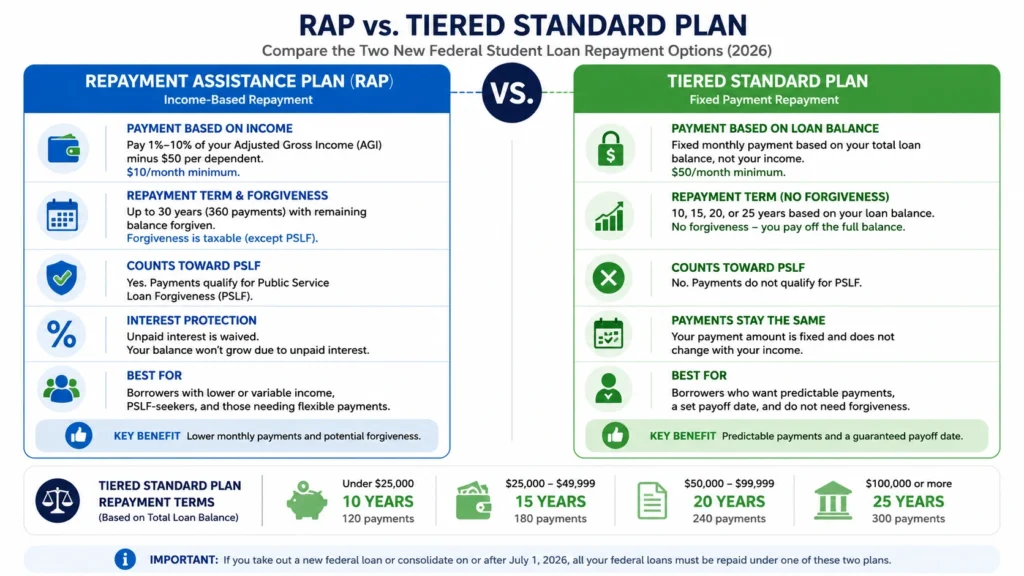
| Payment based on | Income (AGI) + dependents | Loan balance |
| Payment range | $10/month minimum, up to 10% of AGI, no upper dollar cap | Fixed; minimum $50/month |
| Repayment term | Up to 30 years | 10, 15, 20, or 25 years (fixed) |
| Loan forgiveness | Yes, after 360 payments | No |
| Counts toward PSLF | Yes | No |
| Interest subsidy (no negative amortization) | Yes | Not applicable (fully amortizing) |
| Best for | Lower or variable income, PSLF-track borrowers, those wanting the smallest possible current payment | Borrowers who want a predictable payoff date and don’t need income-based payments |
| Default if you don’t choose | No | Yes |
7. RAP vs. SAVE: What Actually Changed for Borrowers
A lot of former SAVE enrollees are asking a simple question: is this better or worse than what I had? The honest answer is “it depends on your income and goals,” but here’s the direct comparison.
| Legal status | Ruled unlawful; being phased out | Fully in effect since July 1, 2026 |
| Payment formula | % of discretionary income above 225% of poverty line | Tiered % (1–10%) of full AGI, minus $50/dependent |
| Interest subsidy | Yes — unpaid interest waived | Yes — unpaid interest waived (similar protection, different mechanism) |
| Forgiveness timeline | 20–25 years | 30 years |
| Payments for very low earners | Could be $0/month | Minimum $10/month (rarely $0) |
| Undergraduate vs. graduate rate | Same formula for both | Same formula for both (based on AGI, not degree level) |
| Current availability | Not available to new enrollees; being eliminated | Available now |
The short version: RAP generally asks for a somewhat higher minimum payment than SAVE did for the lowest earners (SAVE could reach $0/month; RAP’s floor is $10/month), and stretches forgiveness out five to ten years longer. In exchange, it comes with a legally durable structure — SAVE’s core problem wasn’t its formula; it was that courts found it exceeded the Department’s legal authority. RAP was written into the underlying statute directly, which is why it isn’t facing the same kind of existential legal challenge.
8. RAP vs. the Old IBR and PAYE Plans
| Payment basis | 10–15% of discretionary income (income above 150% of poverty line) | 10% of discretionary income | 1–10% of full AGI |
| Forgiveness timeline | 20–25 years | 20 years | 30 years |
| Payment cap | Capped at the 10-year Standard payment amount | Capped at the 10-year Standard payment amount | No cap — scales up with income |
| Dependent adjustment | Built into poverty-line deduction (larger families = lower payment) | Same | Flat $50/month per dependent |
| New enrollment | Only for borrowers who retain legacy access | Closed | Open — only IDR option for new borrowers |
Why this matters: a borrower with $60,000 AGI and no dependents might pay roughly $250/month under RAP, versus roughly $300–$305/month under a 10%-of-discretionary-income IBR calculation for the same income (approximate; it depends on the poverty guideline used). But a lower-income borrower with dependents could see the reverse, since IBR’s poverty-line deduction scales more generously with family size than RAP’s flat $50/dependent credit. There’s no universal “cheaper” answer — it depends on your specific income, family size, and how long you plan to stay in repayment.
9. What Happened to SAVE, PAYE, IBR, and ICR
- SAVE: Effectively dead. Courts found the plan unlawful, and the Department is actively transitioning remaining SAVE borrowers off it. If you’re on SAVE, expect (or already have received) a notice with a 90-day deadline to pick a new plan — otherwise you’ll be auto-enrolled in the Standard or Tiered Standard Plan.
- PAYE and ICR: Closed to new enrollment going forward under the new system; new Direct Loan borrowers after July 1, 2026 cannot enroll in these. Existing enrollees may stay until the plans sunset (no later than July 1, 2028, per the Department of Education); confirm your own plan’s status at StudentAid.gov.
- IBR: Existing IBR borrowers with only pre-July-2026 loans generally retain access to IBR as a legacy option, since IBR has broader statutory protection than the other IDR plans — but this is exactly the kind of detail worth confirming directly with your loan servicer, since implementation guidance has continued to evolve through 2026.
- Standard, Graduated, Extended (old versions): Still available to borrowers whose loans predate July 1, 2026 and who don’t take out new loans or consolidate.
Bottom line: if none of your loans are new, you likely don’t need to do anything except get off SAVE if that’s where you are. If you’re borrowing anything new, you’re in RAP-or-Tiered-Standard territory regardless of what plan your older loans were on.
10. Old System vs. New System: The Complete Overview
| Number of repayment plan types | 6+ (Standard, Graduated, Extended, IBR, PAYE, ICR, SAVE) | 2 (RAP, Tiered Standard) for new borrowers |
| Standard plan term | Fixed 10 years for everyone | Tiered 10/15/20/25 years by balance |
| IDR forgiveness timeline | 20–25 years | 30 years (RAP) |
| Grad PLUS loans | Available up to cost of attendance | Eliminated for new borrowers |
| Graduate annual/lifetime caps | Effectively uncapped via Grad PLUS | $20,500/yr, $100,000 lifetime (general); $50,000/yr, $200,000 lifetime (professional) |
| Deferment options | Broad Economic Hardship & Unemployment Deferment | Phasing out for new loans disbursed after July 1, 2027 |
| Forbearance limits | Largely discretionary/servicer-dependent | Capped at 9 months per 2 years for new loans after July 1, 2027 |
| Interest subsidy on IDR | Varied by plan (SAVE had one; others didn’t fully) | Standardized under RAP |
11. Monthly Payment Examples by Income and Balance
RAP payment examples (illustrative — always verify your exact bracket and percentage at StudentAid.gov):
| $10,000 or less | 0 | $10/month (flat minimum) |
| $25,000 | 2 | $10/month (the formula result falls below the minimum) |
| $55,000 | 0 | ~$229/month |
| $60,000 | 0 | ~$250/month |
| $75,000 | 2 | ~$337/month |
| $120,000 | 1 | ~$900–$950/month |
| $150,000+ | 0 | 10% cap — roughly $1,250/month at $150,000 AGI |
Tiered Standard Plan payment examples (illustrative, calculated at 6.52%, the fixed rate for undergraduate Direct Loans first disbursed July 1, 2026 through June 30, 2027, per Federal Student Aid, checked October 24, 2026 — your real rate is set at disbursement, so treat these as estimates, not quotes):
| $15,000 | 10 years | ~$170 |
| $30,000 | 15 years | ~$262 |
| $45,000 | 15 years | ~$392 |
| $75,000 | 20 years | ~$560 |
| $120,000 | 25 years | ~$812 |
Notice the pattern: RAP tends to produce a much lower initial payment for borrowers with modest income relative to their debt, especially early in their careers — but it stretches repayment to 30 years and, absent PSLF, the forgiven balance is taxed. Tiered Standard produces a higher, fixed payment but a firm end date and no forgiveness to worry about (or rely on).
12. Public Service Loan Forgiveness (PSLF) Under the New Rules
If you’re working toward PSLF, two things matter enormously right now:
1. Only RAP payments count toward PSLF among the new plans. If you enroll in the Tiered Standard Plan, none of those payments will count, even if you work for a qualifying employer. Anyone pursuing PSLF who’s subject to the new two-plan system needs to be on RAP, not Tiered Standard.
2. New employer-eligibility rules were challenged and blocked — for now. Separate from the repayment-plan changes, a new set of PSLF rules was scheduled to take effect July 1, 2026, that would have let the Secretary of Education disqualify certain nonprofit and government employers from PSLF eligibility based on the nature of their activities. Federal courts in Massachusetts and Washington, D.C. vacated those rules on June 30, 2026, so as of this writing they are not in effect. This is genuinely still moving — an appeal or further rulemaking could change this picture, so if PSLF is central to your plan, it’s worth checking StudentAid.gov or your servicer periodically rather than treating this as permanently settled.
3. Loans that predate July 2026 and stay on legacy IDR plans (like IBR) generally continue counting toward PSLF as before, as long as you meet the standard requirements: qualifying employment, a qualifying repayment plan, and 120 qualifying monthly payments.
13. Grad PLUS Elimination and New Borrowing Caps
Separately from the repayment overhaul, the same legislation eliminated the Grad PLUS loan program for new borrowers starting with the 2026–27 academic year (effective July 1, 2026). Grad PLUS had let graduate and professional students borrow up to their full cost of attendance; that’s gone for anyone starting a new program on or after that date.
New annual and lifetime caps on Direct Unsubsidized Loans for graduate/professional students:
| Graduate students (most master’s programs) | $20,500 | $100,000 |
| Professional students (law, medicine, dentistry, and similar statutorily defined professional programs) | $50,000 | $200,000 |
| Overall federal lifetime cap, all levels combined (excludes Parent PLUS) | — | $257,500 |
| Parent PLUS (per dependent student) | $20,000 | $65,000 |
A legacy transition window exists: if you already had a Grad PLUS loan or a Direct Unsubsidized Loan disbursed before July 1, 2026 while enrolled in a program, you can generally continue borrowing under the prior rules for up to three more academic years, or the remainder of your expected time to complete the credential — whichever comes first.
The practical effect: graduate and professional students whose program costs exceed these new caps will need to fill the gap with private loans, institutional aid, or savings — a real shift for high-cost programs like law and medicine, where full cost of attendance regularly exceeded the new caps under the old Grad PLUS system.
14. Undergraduate vs. Graduate Borrowers: What Changes for Each
| Direct Loan annual/aggregate limits | Largely unchanged for 2026–27 | New, lower annual/lifetime caps (see Section 13) |
| Grad PLUS access | Not applicable | Eliminated for new borrowers |
| Repayment plan options (new loans) | RAP or Tiered Standard | RAP or Tiered Standard |
| Typical balance impact | Modest; most changes are on the repayment side | Significant — high-cost programs (law, medicine, MBA) may face real funding gaps |
| Parent PLUS relevance | High — many dependent undergrads rely on parent borrowing | Not applicable |
Undergraduate borrowers: Direct Subsidized and Unsubsidized Loan annual and aggregate limits for dependent and independent undergraduates are not the primary target of this overhaul — the bigger changes for undergrads are on the repayment side (RAP/Tiered Standard) and the Parent PLUS caps, which affect how much a parent can borrow on a student’s behalf.
Graduate and professional borrowers: This is where the most significant new limits land — the end of Grad PLUS and the new annual/lifetime caps described above. If you’re applying to a graduate or professional program starting in fall 2026 or later, run the math on your program’s real cost of attendance against the new caps before you enroll, not after.
15. Parent PLUS Loans: What Changed for Parents
Parent PLUS borrowing is one of the most significantly restructured pieces of this overhaul, and it’s easy to miss if you’re focused only on student-facing changes.
| Annual borrowing limit | Up to full cost of attendance minus other aid | $20,000 per dependent student, per year |
| Lifetime borrowing limit | No fixed cap (tied to cost of attendance across years) | $65,000 per dependent student |
| RAP eligibility | Not applicable (RAP is new) | Not eligible directly for RAP |
| Default repayment plan for new Parent PLUS loans | Standard 10-year plan | Tiered Standard Plan |
| PSLF path | Available via Direct Consolidation Loan + ICR (legacy) | More limited — Parent PLUS consolidated into a Direct Consolidation Loan with an underlying Parent PLUS loan remains ineligible for RAP; check current guidance for the narrower PSLF path that may still apply |
What this means practically: parents who previously covered a full tuition gap with Parent PLUS may now hit the $20,000/year or $65,000 lifetime ceiling well before covering a private four-year education, especially at higher-cost schools. Families in this position typically need to combine Parent PLUS (up to the new cap), the student’s own federal borrowing, and either private parent/student loans or additional savings to close the remaining gap.
16. Federal vs. Private Student Loans in 2026
With Grad PLUS gone and new borrowing caps in place, more borrowers — especially in graduate and professional programs — are going to face a funding gap that federal loans won’t fully cover. That’s pushing more borrowers toward private student loans to fill the difference.
| Underwriting | No credit check for most undergrad loans | Credit- and income-based; often requires a cosigner for younger borrowers |
| Repayment plans | RAP, Tiered Standard, legacy IDR (if eligible) | Lender-specific; typically fixed terms of 5–20 years |
| Forgiveness programs | RAP (30 yr), PSLF (10 yr for public service) | Generally none |
| Interest rates (2026) | Fixed, set annually by Congress for the loan year | Fixed roughly 3–16% APR or variable, depending on lender, credit, and term (rates change frequently — always check current lender disclosures) |
| Deferment/forbearance | Federally standardized (though narrowing for post-2027 loans) | Varies significantly by lender |
| Death/disability discharge | Federally guaranteed discharge | Varies by lender — not guaranteed |
The tradeoff is real: federal loans come with RAP, PSLF eligibility, and other borrower protections that private loans generally don’t offer. Private loans are underwritten on credit and income, often require a cosigner for younger borrowers, and don’t carry income-driven repayment or federal forgiveness programs. If you’re weighing a private loan to cover a gap left by the new caps, treat it as a last-resort supplement to federal borrowing, not a replacement for it, and compare rates and terms across multiple lenders before committing.
17. RAP vs. Refinancing Into a Private Loan
A specific, high-stakes question: should you refinance existing federal loans into a private loan to get a lower rate, instead of using RAP?
| Interest rate | Federal rate set at disbursement (fixed) | Potentially lower fixed or variable rate for strong-credit borrowers, often in the roughly 3–16% APR range depending on lender and credit profile |
| Income-based payment | Yes | No — private lenders generally offer fixed terms only |
| Forgiveness eligibility | Yes (RAP after 30 yrs; PSLF after 10 yrs if qualifying) | No — refinancing permanently forfeits federal forgiveness and PSLF eligibility |
| Interest subsidy protection | Yes | No |
| Best fit | Uncertain or lower income, any interest in PSLF, want to preserve flexibility | High, stable income, no interest in PSLF or federal forgiveness, strong credit for a meaningfully better rate |
The irreversible part: once you refinance federal loans into a private loan, you cannot undo it — you permanently give up RAP, PSLF eligibility, the interest subsidy, and federal deferment/forbearance options. This decision only makes sense when your income and credit profile are strong and stable enough that you’re confident you’ll never need those federal protections.
18. Tax Implications of Loan Forgiveness
This is one of the most overlooked pieces of the new system. A temporary federal tax exemption for IDR-related loan forgiveness (originally part of 2021 pandemic-era relief) expired at the end of 2025 and has not been extended. That means:
- Forgiveness earned through RAP after 30 years is generally treated as taxable ordinary income in the year it’s forgiven, under current law.
- Forgiveness through PSLF remains tax-free at the federal level, regardless of which qualifying plan (including RAP) you used to get there.
- State tax treatment varies — some states tax forgiven federal student debt as income even when it’s federally tax-free or federally taxable in different ways, so check your specific state’s rules as your forgiveness date approaches.
If you’re on a 30-year RAP timeline without PSLF, it’s worth starting to plan for a potential “tax bomb” well before year 25 — talk to a tax professional a few years out, not the year it happens.
19. Pros and Cons of Each Plan
RAP — Pros:
- Payments scale down with income; can be very low for lower earners.
- No negative amortization — the government waives excess unpaid interest.
- Guaranteed minimum $50/month principal reduction
- Counts toward PSLF
- MFS filing option can exclude a spouse’s income
RAP — Cons:
- 30-year timeline to forgiveness — a full decade longer than most old IDR plans
- Forgiven balance is taxable outside of PSLF.
- No payment cap at higher incomes (payment keeps rising with income, unlike some older plans that capped at the 10-year standard payment amount)
Tiered Standard Plan — Pros:
- Fixed, predictable payment and payoff date
- No 30-year overhang, no forgiveness-related tax bill to plan for
- Simple to understand — no annual income recertification required
Tiered Standard Plan — Cons:
- Doesn’t adjust if your income drops
- Does not count toward PSLF
- No forgiveness — you pay the loan off in full.
20. Real Borrower Scenarios
(These are illustrative composite scenarios, not real individuals, built to show how the math actually plays out.)
Scenario 1: The new teacher pursuing PSLF. Maria graduates with $32,000 in federal loans and takes a public school teaching job at $42,000/year. She has no dependents. Under RAP, her estimated payment is about $140/month (4% of $42,000 AGI ÷ 12, before any dependent deductions) — low enough to manage on a starting teacher’s salary — and every qualifying payment counts toward PSLF. If Maria stays in public service for 10 years and makes 120 qualifying payments, her remaining balance is forgiven completely tax-free, regardless of what’s left. Choosing the Tiered Standard Plan instead would have locked her into about $280/month over 15 years with zero PSLF credit — a costly mistake for her specific goal.
Scenario 2: The mid-career professional who wants a fixed payoff date. David owes $45,000 with a stable $85,000 salary and no plans for public service work. Under RAP, his payment would land somewhere around $550–$600/month, stretching toward a theoretical 30-year forgiveness he doesn’t actually need, with an eventual tax bill on any remainder. Under the Tiered Standard Plan, his fixed payment on a 15-year term is roughly $392/month — for many borrowers in David’s position, actually lower than the RAP estimate at his income level, with a hard payoff date and no forgiveness-related tax exposure. This is exactly the kind of case where running both numbers before choosing matters more than defaulting to whichever plan sounds more generous on paper.
Scenario 3: The graduate student facing the new borrowing caps. Priya is starting an MBA program in fall 2026 with an expected total cost of attendance of $140,000. Under the old system, Grad PLUS would have covered the difference after her Direct Unsubsidized Loan. Under the new rules, she’s capped at $20,500/year in Direct Unsubsidized Loans (with a $100,000 lifetime cap), so over a two-year program she can borrow at most about $41,000 — roughly a $99,000 shortfall she’ll need to cover through savings, employer tuition assistance, or a private loan, which she should shop for well before enrollment rather than after her first tuition bill arrives.
Scenario 4: The parent covering a gap for a dependent undergrad. The Alvarez family previously planned to use Parent PLUS to cover a $28,000 gap per year at their daughter’s private university. Under the new $20,000/year, $65,000 lifetime Parent PLUS caps, they can cover less than they’d planned across four years, and need to revisit their financing plan — likely a mix of increased student borrowing (within federal limits), a payment plan with the school, or a private parent loan for the remainder.
21. Common Myths vs. Facts
| “SAVE will come back if I just wait it out.” | SAVE has been ruled unlawful and is being actively eliminated — there’s no indication it’s returning in its prior form. |
| “All student loan forgiveness is tax-free.” | Only PSLF remains tax-free federally. RAP forgiveness after 30 years is generally taxable as ordinary income absent PSLF. |
| “I have to switch to RAP or Tiered Standard even if my loans are old.” | Not necessarily — if you don’t take out new loans or consolidate after July 1, 2026, you generally keep your existing legacy plan. |
| “The Tiered Standard Plan is basically the same as the old Standard Plan.” | Not for larger balances — the old plan was a flat 10 years for everyone; the new plan extends the term up to 25 years based on your balance. |
| “Refinancing federal loans into a private loan is always smarter if I can get a lower rate.” | A lower rate doesn’t replace the value of RAP, PSLF eligibility, and federal protections — refinancing is irreversible and only makes sense for borrowers confident they’ll never need those benefits. |
| “Grad PLUS elimination means I can’t get any federal aid for grad school.” | You can still borrow via Direct Unsubsidized Loans — just with new, lower annual and lifetime caps than Grad PLUS previously allowed. |
| “PSLF is being eliminated.” | No — the core PSLF program (120 qualifying payments) remains. A separate set of proposed employer-eligibility restrictions was blocked by courts as of June 30, 2026. |
22. Common Mistakes to Avoid
- Assuming your old plan automatically carries over. If you borrow anything new on or after July 1, 2026, your plan options may change, possibly including for older loans. Confirm with your loan servicer before borrowing or consolidating.
- Choosing Tiered Standard while pursuing PSLF. This is the single costliest mistake possible under the new rules, since none of those payments will count.
- Not recertifying income for RAP on schedule. Missing your annual recertification can bump your payment to a higher default amount.
- Ignoring the SAVE transition notice. If you’re on SAVE and miss your 90-day window, you’ll be auto-enrolled into a plan that may not be your best option.
- Forgetting the tax exposure at the end of a RAP term. Not planning for a potential tax bill on forgiveness outside of PSLF can create a painful surprise 30 years down the line.
- Assuming Parent PLUS is eligible for RAP. It isn’t — Parent PLUS borrowers have a different, narrower set of options.
- Overlooking the new graduate borrowing caps when planning for grad school. Committing to an expensive program before checking whether federal loans will cover it can leave a costly last-minute funding gap.
- Picking a plan based on the lowest monthly payment alone. As Scenario 2 shows, the plan with the lowest sticker-price payment isn’t always the cheapest option once you factor in total interest and tax exposure over the life of the loan.
- Refinancing federal loans into private ones without running the PSLF and RAP numbers first. This decision is permanent — model it carefully before committing.
23. Hidden and Advanced Repayment Strategies
- Time your income recertification strategically. If you know your income is about to drop (career change, going back to school, parental leave), recertifying right before that dip locks in a lower payment sooner rather than waiting for your standard annual date.
- Coordinate RAP with employer student loan repayment benefits. Some employers offer tax-free student loan repayment assistance up to an annual limit; combining this with a low RAP payment can meaningfully accelerate principal payoff without increasing your taxable income.
- Model the “PSLF or bust” decision early, not late. If there’s any realistic chance you’ll work in public service for 10 years, enrolling in RAP from day one preserves that option; switching plans later can complicate your qualifying-payment count.
- Consider partial refinancing. Some borrowers refinance only their higher-rate private loans while keeping federal loans on RAP or Tiered Standard — preserving federal protections on the loans that need them most.
- Watch your dependent count each tax year. Since RAP’s dependent deduction is based on your tax return, a life change (a new child, a dependent aging out) directly changes your payment — recalculate whenever this shifts.
- For married borrowers, model both MFJ and MFS scenarios before filing. The RAP MFS exclusion can lower your payment, but it may increase your total tax bill elsewhere — this needs a side-by-side comparison, not a rule of thumb.
24. How to Choose the Right Plan for You
Use this simple decision path:
- Are you pursuing PSLF (or might you, in a public service career)? → Choose RAP. Tiered Standard doesn’t count.
- Is your income currently low relative to your balance, and you expect it to grow over time? → RAP likely gives you breathing room now, with the tradeoff of a longer timeline and eventual taxable forgiveness if you’re not on PSLF.
- Do you want a firm payoff date and don’t want to deal with annual income recertification? → Tiered Standard Plan.
- Is your balance relatively small (under $25,000) and your income solid? → Tiered Standard’s 10-year term may cost you less in total interest than stretching to 30 years under RAP.
- Not sure? Run your numbers through both formulas (or an official StudentAid.gov calculator) before you decide — this is not a plan you want to guess on, since switching later has its own complications, including losing progress toward RAP-specific forgiveness if you leave and come back.
Decision tree, in plain text:
- Working in (or planning to work in) public service? → Yes: RAP. No: go to step 2.
- Is your income low or unstable relative to your balance right now? → Yes: RAP. No: go to step 3.
- Do you want the lowest possible total interest paid and a firm end date? → Yes: Tiered Standard. No: RAP.
25. Interactive Tools to Use Before You Decide
Don’t finalize a plan choice from estimates alone — run your actual numbers first. Before you commit, use:
- A RAP payment calculator — enter your AGI, filing status, and dependents to get your exact estimated monthly payment.
- A Tiered Standard payment calculator — enter your total balance and estimated interest rate to see your fixed payment and total interest over the full term.
- A PSLF eligibility checker — confirm your employer and payment history actually qualify before you commit years of payments to that path.
- A loan forgiveness tax-impact estimator — model what a taxable RAP forgiveness event could mean for your tax bill decades from now, in today’s dollars.
- A federal vs. private refinance comparison tool — see the real side-by-side cost, not just the headline rate, before giving up federal protections.
26. Timeline of Key Deadlines
| July 1, 2026 | RAP and Tiered Standard Plan become available; they’re the only options for new Direct Loan borrowers or anyone consolidating after this date |
| July 1, 2026 | Grad PLUS loan program closes to new borrowers |
| July 1, 2026 | SAVE plan wind-down begins; servicers start issuing 90-day transition notices |
| Within 90 days of your notice | Deadline to choose a new plan if you’re on SAVE, or be auto-enrolled |
| July 1, 2027 | Economic Hardship and Unemployment Deferment options end for new Direct Loans disbursed on or after this date |
| July 1, 2027 | Forbearance limited to 9 months every 2 years for new loans disbursed after this date |
| Up to 3 academic years from July 1, 2026 | Legacy Grad PLUS / Direct Unsubsidized borrowing window closes for students already mid-program before the cutoff |
27. Expert Tips
- Recalculate your numbers every time your income changes materially, not just at annual recertification — RAP responds to AGI, so a raise, a new job, or a dependent change shifts your payment.
- If you’re newly out of school with a low starting salary, RAP’s built-in interest subsidy is arguably its most underrated feature — it’s the difference between a loan that grows even while you’re paying, and one that doesn’t.
- If you’re weighing Tiered Standard vs. RAP purely on cost, run a full amortization comparison, not just the monthly payment — a lower monthly payment over 30 years can cost more in total interest than a higher payment over 10–15 years.
- Set a calendar reminder years before a projected RAP forgiveness date to start tax planning, especially if you’re not on the PSLF track.
- If you’re a grad or professional student, get your program’s real total cost of attendance in writing before enrolling and compare it against the new borrowing caps — don’t discover the gap after you’ve already committed.
- If you’re a Parent PLUS borrower, model the new $20,000/year cap against your child’s full four-year cost before senior year of high school, not after the first tuition bill arrives.
28. Future Outlook and Latest Legal Developments
This system is genuinely new, and several pieces are still in motion: the vacated PSLF employer-eligibility rules could return in a revised form after appeal; further guidance on legacy-plan protections is still being issued; and states are actively deciding how to tax RAP forgiveness going forward. Expect continued clarifying guidance from the Department of Education through the rest of 2026 and into 2027, particularly as the first cohorts of RAP borrowers hit their first income recertification cycle.
Latest legal developments to watch:
- The Massachusetts and D.C. district court rulings vacating the new PSLF employer-eligibility rules (June 30, 2026) are likely to be appealed — a higher court could reinstate, modify, or permanently strike down those rules.
- Guidance on exactly which legacy IDR plans (beyond IBR) remain open to which pre-2026 borrowers has continued to be refined by the Department throughout 2026 and may shift further.
- State legislatures are actively considering whether to exempt RAP and other IDR forgiveness from state income tax, following the expiration of the federal exemption at the end of 2025 — this varies by state and is worth checking annually if you’re on a forgiveness track.
If you’re deep into a repayment strategy built around a specific interpretation of these rules, it’s worth checking StudentAid.gov or your servicer at least twice a year rather than treating any single article — including this one — as the permanent last word.
29. Frequently Asked Questions
1. What are the two new student loan repayment plans? The Repayment Assistance Plan (RAP), which is income-based, and the Tiered Standard Plan, which is a fixed payment based on your loan balance. Both became available July 1, 2026.
2. Do I have to switch plans if my loans are from before July 2026? Not automatically. If you don’t take out any new federal loans or consolidate after July 1, 2026, you generally keep your existing repayment plan, with the exception of SAVE, which is being phased out entirely.
3. What happened to the SAVE plan? Courts found it unlawful, and it’s being wound down. Enrollees are receiving notices with a roughly 90-day window to choose a new plan before being auto-enrolled in the Standard or Tiered Standard Plan.
4. Can I still get on PAYE or ICR? No. New enrollment in PAYE and ICR closed as part of this overhaul; new Direct Loan borrowers after July 1, 2026 can only choose RAP or Tiered Standard.
5. Is IBR still available? Borrowers with only pre-July-2026 loans generally retain access to IBR as a legacy option. Confirm your specific status with your loan servicer, since implementation details have continued to evolve.
6. How is my RAP payment calculated? It’s based on a tiered percentage (roughly 1%–10%) of your adjusted gross income, divided by 12, minus $50 per dependent, with a $10/month minimum floor.
7. Is there a maximum RAP payment? The percentage caps at 10% of AGI, but there’s no fixed dollar ceiling — payments scale up as income rises.
8. What is the interest subsidy under RAP? If your payment doesn’t cover the interest that accrued that month, the government waives the shortfall instead of adding it to your balance, so your loan can’t grow through unpaid interest.
9. How long until RAP forgives my balance? 360 qualifying monthly payments — 30 years — assuming you’re not also pursuing PSLF, which has its own 120-payment timeline.
10. Is RAP forgiveness taxable? Generally yes, as ordinary income, unless the forgiveness comes through PSLF, which remains tax-free federally.
11. How does the Tiered Standard Plan set my term? Your total federal loan balance determines it: under $25,000 gets 10 years, $25,000–$49,999 gets 15 years, $50,000–$99,999 gets 20 years, and $100,000 or more gets 25 years.
12. Does the Tiered Standard Plan qualify for PSLF? No. If you’re working toward PSLF, you need to be on RAP, not Tiered Standard.
13. What’s the minimum payment on the Tiered Standard Plan? $50 per month, or your remaining balance if it’s less than $50.
14. Can Parent PLUS loans use RAP? No. Parent PLUS loans are not eligible for RAP. They generally default to the Tiered Standard Plan unless consolidated in a way that changes eligibility.
15. What happened to Grad PLUS loans? The program closed to new borrowers starting July 1, 2026. Graduate and professional students now rely on Direct Unsubsidized Loans with new, lower annual and lifetime caps.
16. What are the new graduate loan limits? $20,500 per year and $100,000 lifetime for most graduate programs; $50,000 per year and $200,000 lifetime for professional programs like law and medicine.
17. Is there an overall lifetime federal loan limit? Yes, $257,500 across all federal student loans combined (excluding Parent PLUS amounts).
18. What if I already had a Grad PLUS loan before July 2026? You can typically continue borrowing under the old rules for up to three more academic years, or the rest of your expected time to finish your credential, whichever is shorter.
19. Will my monthly payment go up or down under the new system? It depends entirely on your income and balance. Lower-income borrowers with high balances often see a lower initial payment under RAP; borrowers with smaller balances and steady income may pay more, sooner, but finish faster under Tiered Standard.
20. Can I switch from RAP to Tiered Standard, or vice versa? Generally yes, but switching plans can affect your progress toward forgiveness, so confirm with your loan servicer how a switch would affect your qualifying-payment count before you change plans.
21. Does married filing separately actually lower my RAP payment? It can, since RAP allows married borrowers filing separately to exclude a spouse’s income from the calculation — but filing separately has its own tax tradeoffs, so consult a tax professional before changing your filing status for this reason alone.
22. What happens if I miss my RAP income recertification? Your payment can reset to a higher default amount until you recertify, so keep your recertification date on your calendar.
23. Are FFEL, Perkins, or HEAL loans affected by RAP or Tiered Standard? No — those loan types aren’t eligible for either new plan and stay on their existing repayment options.
24. What’s the deadline if I’m still on the SAVE plan? Servicers are issuing individual 90-day deadlines as part of the transition; watch for that notice specifically, since the exact date depends on when your servicer contacts you.
25. Is Public Service Loan Forgiveness itself changing? The core 120-qualifying-payment PSLF structure remains, but a set of new employer-eligibility restrictions was blocked by federal courts on June 30, 2026, so as of now those restrictions are not in effect — though this is still an active legal area to watch.
26. Should I refinance my federal loans into a private loan to avoid all this? Refinancing federal loans into private ones means permanently giving up RAP, PSLF eligibility, and other federal protections — generally not advisable unless you have high, stable income, no interest in PSLF, and can secure a meaningfully lower private rate.
27. Where can I get my official, exact RAP payment number? StudentAid.gov’s official RAP calculator and your loan servicer’s account portal will give you the precise figure for your situation — this guide’s examples are illustrative.
28. How much total student loan debt exists in the U.S. right now? About $1.66 trillion as of Q1 2026 and $1.65 trillion as of Q2 2026, according to the New York Fed’s Household Debt and Credit Report, which is based on credit-report data (per NY Fed, Source).
29. What’s the average student loan balance in 2026? Average and median balances vary by data source and methodology. For official federal portfolio figures, check the Federal Student Aid Data Center on StudentAid.gov.
30. Does RAP affect my credit score differently than other plans? Making on-time RAP payments is reported to credit bureaus like any other loan payment and can help build positive payment history; missing payments hurts your score the same way it would under any repayment plan.
31. Can I get RAP or Tiered Standard if my loans are already in default? Generally, you need to resolve default status first — through loan rehabilitation or consolidation — before enrolling in either new plan. Contact your servicer to start that process.
32. What happens to my RAP payments if I become unemployed? Your next recertification will reflect your lower or zero income, generally reducing your payment toward the $10/month floor; some deferment or forbearance options may also be available in the interim, though these are being narrowed for loans disbursed after July 1, 2027.
33. Does disability discharge still exist under the new system? Total and Permanent Disability (TPD) discharge remains a separate federal program, independent of the RAP/Tiered Standard changes, and continues to be available to eligible borrowers.
34. Can student loans be discharged in bankruptcy under the new rules? Federal student loan discharge in bankruptcy still requires proving “undue hardship” under existing legal standards; this overhaul did not change that bankruptcy standard directly.
35. How often do I need to recertify my income for RAP? Generally annually, similar to prior income-driven plans — mark your recertification date and update it any time your income changes materially in the meantime.
36. Is there a grace period before repayment starts under the new plans? Standard federal grace period rules (typically six months after leaving school) are unchanged by this overhaul; RAP and Tiered Standard apply once you enter repayment.
37. Do private student loans qualify for RAP or PSLF? No. RAP and PSLF apply only to eligible federal Direct Loans — private loans are never eligible for either program.
38. What’s the difference between “consolidation” triggering the new rules and just staying on my current loan? Consolidating combines your loans into a new Direct Consolidation Loan, which counts as a “new loan” under the rules — meaning consolidating after July 1, 2026 moves all your consolidated debt onto RAP or Tiered Standard, even if the underlying loans predate that date.
39. Are there income limits to qualify for RAP, or is it open to everyone? RAP is open to eligible federal Direct Loan borrowers regardless of income — the percentage you pay simply scales up as your income rises, with no upper income cutoff for eligibility.
40. How does RAP treat borrowers with no income at all (unemployed, in school, etc.)? An AGI at or below roughly $10,000 results in the flat $10/month minimum payment under RAP.
41. What’s the average monthly student loan payment for U.S. borrowers? It varies enormously by balance, income, and repayment plan. Your loan servicer account shows your actual required payment.
42. If I’m on Tiered Standard and my income drops significantly, can I switch to RAP? Yes, borrowers can generally switch between RAP and Tiered Standard, though it’s worth confirming current rules with your servicer, since switching can affect forgiveness-related payment counts.
43. Does the professional-degree definition for the higher $50,000/$200,000 caps include all graduate programs? No — it applies specifically to statutorily defined professional degree programs (such as law and medicine); most other graduate programs, including most master’s degrees and MBAs, fall under the lower $20,500/$100,000 general graduate cap.
44. Will my current loan servicer change because of this overhaul? Not necessarily — servicer assignments are separate from the repayment plan changes, though servicers have been actively communicating with borrowers about the SAVE transition and new plan options.
45. Can I use a 529 plan or other savings alongside RAP to pay down my balance faster? Yes — RAP sets your required minimum payment, but you can generally make additional voluntary payments toward principal at any time, which can meaningfully shorten your effective payoff timeline if you’re not relying on eventual RAP forgiveness.
46. Do RAP and Tiered Standard apply to loans held by borrowers who are not U.S. citizens? Federal Direct Loan eligibility generally requires U.S. citizenship or eligible non-citizen status at origination; the repayment plan rules themselves (RAP, Tiered Standard) apply the same way to all eligible Direct Loan borrowers regardless of when they originated the loan, as long as it’s a covered loan type.
47. Where should I go for authoritative, up-to-date information beyond this guide? StudentAid.gov, your loan servicer’s official communications, and Department of Education press releases are the most authoritative and current sources — treat any third-party guide, including this one, as a starting point for understanding the mechanics, not the final word on your specific situation.
30. Final Summary and Action Steps
The federal student loan system didn’t get simpler by accident — it got simpler because the old system, especially the SAVE plan, had become legally and administratively unworkable. What you’re left with now is two genuinely different tools: RAP, built for borrowers who need income flexibility and a shot at forgiveness (especially through PSLF), and the Tiered Standard Plan, built for borrowers who want predictability and a firm finish line. With roughly $1.65 trillion in student debt outstanding (NY Fed, Q2 2026), this overhaul touches nearly everyone with a federal loan balance in some way — even those who don’t need to act immediately.
Your action steps:
- Check whether you’re taking out any new loans or planning to consolidate after July 1, 2026 — that determines whether any of this applies to you right now.
- If you’re on SAVE, watch for your servicer’s transition notice and don’t let the 90-day window lapse without a decision.
- If PSLF is part of your plan, confirm you’re enrolled in RAP, not Tiered Standard.
- Run your actual numbers through StudentAid.gov’s official calculator before committing to a plan.
- If you’re heading into graduate or professional school, check your program’s real cost against the new borrowing caps before you enroll.
- If you’re a parent using Parent PLUS, model the new $20,000/year cap against your family’s actual need well before tuition bills arrive. Our 50/30/20 budgeting guide can help, and the loan payment calculator lets you test different balances, rates and terms.
None of this is set-and-forget. Put a reminder on your calendar to revisit your plan choice at least once a year — the rules around you are still settling, and the plan that fits today may not be the one that fits in five years.
Sources Reviewed
- U.S. Department of Education (ed.gov) — program guidance and press releases on RAP, Tiered Standard Plan, and Grad PLUS elimination
- StudentAid.gov — official RAP and Tiered Standard Plan program pages
- Internal Revenue Service (IRS) — guidance on the taxability of discharged student debt
- Consumer Financial Protection Bureau (CFPB) — consumer-facing guidance on federal loan servicing and borrower protections
- Federal Reserve — survey data on borrower payment amounts and household student debt
- Independent financial-data publishers (cross-checked against the above primary sources) for aggregate statistics on total debt, borrower counts, and average balances.

FinovativeHub Editorial Team publishes personal finance guides for American readers, covering budgeting, credit cards, loans, and retirement accounts. We aim to explain how things work in plain English and to cite official sources, such as the IRS, where they apply. Rates, fees, and limits change, so confirm current terms with the provider or agency before you act.
Pingback: Credit Card Delinquencies Hit a 16-Year High (2026 Data Explained)