Quick answer: The 2026 401(k) contribution limits start with $24,500 in employee deferrals to a 401(k), 403(b), governmental 457(b) or the federal Thrift Savings Plan. The limit for a traditional and Roth IRA combined is $7,500. People 50 and older can add catch-up contributions. Payroll deferrals generally have to come out of paychecks by December 31, so mid-October is a good time to check your year-to-date total. IRA contributions for 2026 can be made until the federal tax filing deadline in April 2027, not counting extensions.
This guide covers the official 2026 numbers, shows how to work out a per-paycheck amount, explains the main trade-offs and flags what is still only a projection for 2027. It is general education, not personalized tax or investment advice.
Table of Contents
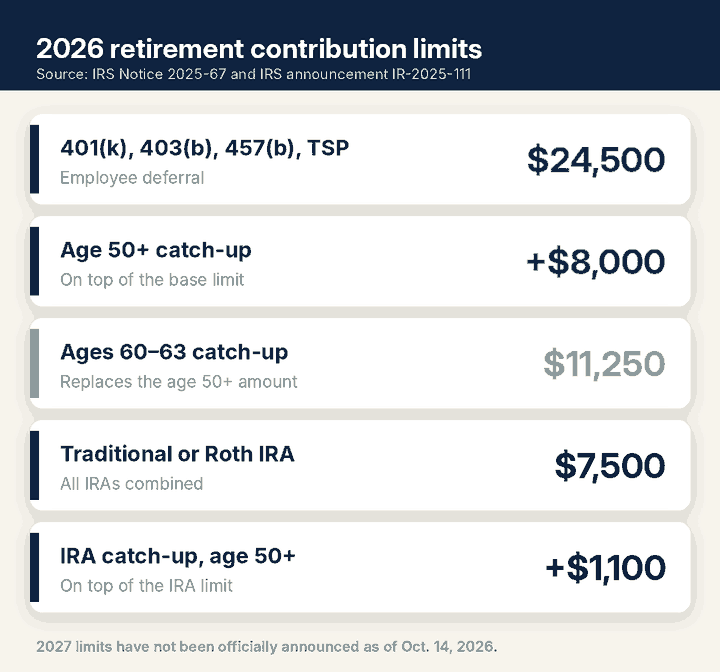
The official 2026 401(k) contribution limits and IRA limits
These figures come from the IRS announcement of the 2026 cost-of-living adjustments (IRS: 401(k) limit increases to $24,500 for 2026, IRA limit increases to $7,500) and IRS Notice 2025-67. The 2025 figures are in IRS Notice 2024-80.
| Account or contribution type | 2025 limit | 2026 limit |
|---|---|---|
| Employee deferral: 401(k), 403(b), governmental 457(b), TSP | $23,500 | $24,500 |
| Catch-up, age 50 and older (in these plans) | $7,500 | $8,000 |
| Catch-up for those who turn 60, 61, 62 or 63 during the year (plan must allow it; replaces the age 50 catch-up) | $11,250 | $11,250 |
| Traditional and Roth IRA, combined | $7,000 | $7,500 |
| IRA catch-up, age 50 and older | $1,000 | $1,100 |
| Overall annual additions limit, employee plus employer contributions (401(k) plans) | $70,000 | $72,000 |
Employee, catch-up and employer contributions: what is the difference?
| Type | Who contributes | 2026 limit that applies |
|---|---|---|
| Employee deferral | You, from your paycheck | $24,500 |
| Catch-up contribution | You, if you are 50 or older and your plan allows it | $8,000 (or $11,250 if you turn 60 to 63 this year) |
| Employer contribution (match or profit sharing) | Your employer | Counts toward the $72,000 overall limit, not your $24,500 |
A few details that are easy to miss:
- The deferral limit is per person, not per plan. The IRS says you generally add up your elective deferrals to all plans you take part in to check against the limit. If you changed jobs this year, count contributions at both employers.
- The employer match is separate. The IRS lists the overall limit as $72,000 for 2026 ($80,000 including catch-up contributions, or up to $83,250 for those age 60 to 63), per its 401(k) contribution limits page.
- A 401(k) catch-up contribution in 2026 depends on your plan. The IRS says catch-ups “may be permitted by these plans.” Check that your plan allows them, and that it supports the higher ages 60 to 63 amount.
- Roth catch-up rule for higher earners. Starting in 2026, if your prior-year wages from the plan sponsor were above $150,000, catch-up contributions in plans that offer a Roth option generally must be made as Roth contributions, according to the IRS’s catch-up contributions page and Notice 2025-67. Ask your plan administrator how this applies to you.
- IRA limit. The 2026 IRA contribution limits apply to all your traditional and Roth IRAs together, and you cannot contribute more than your taxable compensation for the year, per the IRS’s IRA contribution limits page. With the catch-up, the limit for people 50 and older is $8,600.
Step 1: Find your year-to-date contributions
Look at your latest pay stub or your retirement plan portal. You need the year-to-date total of your contributions, not including any employer match. Traditional (pre-tax) and Roth 401(k) deferrals count toward the same $24,500.
Step 2: Calculate the per-paycheck amount to reach your target
The formula is simple:
(Target for the year − contributed so far) ÷ paychecks remaining = new contribution per paycheck
The examples below use made-up numbers to show the math. They assume you are not yet 50, so the target is the $24,500 base limit. They are not recommendations, and your target does not have to be the maximum.
| Example | Contributed so far | Gap to $24,500 | Paychecks left | Needed per paycheck |
|---|---|---|---|---|
| Biweekly pay | $15,000 | $9,500 | 6 | about $1,583 ($9,500 ÷ 6) |
| Semi-monthly pay | $18,000 | $6,500 | 5 | $1,300 ($6,500 ÷ 5) |
| Monthly pay | $22,000 | $2,500 | 3 | about $833 ($2,500 ÷ 3) |
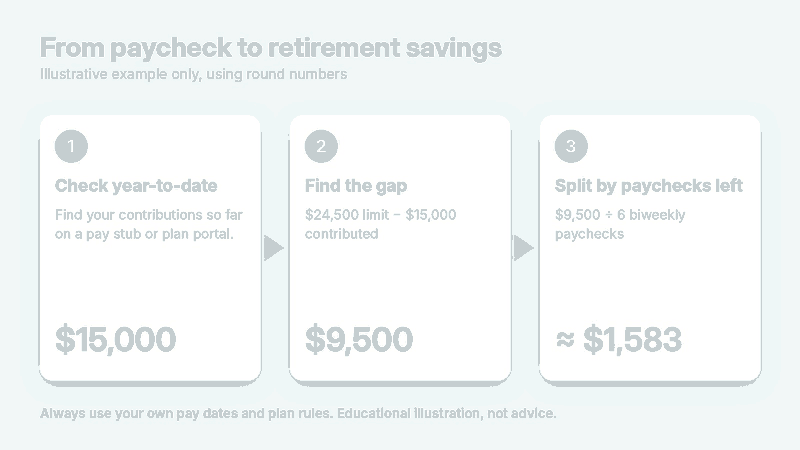
Count your remaining pay dates from your employer’s payroll calendar instead of guessing, because the number of paychecks left varies by employer and pay schedule. Many payroll systems also take a percentage of pay rather than a dollar amount, so you may need to convert. If you are close to the limit, be careful not to exceed it: some plans stop deferrals automatically at the limit, and some do not.
Step 3: Check whether your budget can absorb it
Raising your deferral sharply for a few paychecks lowers your take-home pay. With a traditional 401(k), part of that is offset by lower income tax withholding. As a simplified illustration: if $9,500 of extra pre-tax contributions fell entirely within a hypothetical 22% federal marginal bracket, federal income tax for the year could be roughly $2,090 lower ($9,500 × 0.22), so the net cash effect would be closer to $7,410. Your real result will differ. State income taxes, your actual brackets and credits matter, and Social Security and Medicare taxes still apply to 401(k) deferrals. Roth contributions give no upfront tax reduction at all.
Our budget calculator can help you test different savings amounts. If a big jump would strain your cash flow, the 50/30/20 budgeting rule is one way to see whether the extra savings could come from the “wants” category before it touches essentials. It also helps to keep an emergency cushion before locking more money into retirement accounts, because early withdrawals can be taxed and may carry a 10% additional tax.
To see which bracket your next dollar falls in, read our guide to the 2026 tax brackets and standard deduction. If your employer offers a health FSA, our FSA deadline guide covers another year-end deadline, and our comparison of high-yield savings and CDs covers where to keep cash while you build an emergency fund.
Priorities if you cannot max out
- Capture the full employer match first. Check how much you must contribute to receive all of it. Some plans match each paycheck, so contributing the maximum early in the year and then stopping can cost you match money. Other plans “true up” at year-end. Your plan documents or HR team can tell you which applies.
- Build a basic emergency fund. Retirement accounts are not meant for short-term cash needs.
- Pay down very high-interest debt. Credit card interest is often far higher than investment returns you can count on. Our guide to balance transfer credit cards explains one way to cut interest costs, including the fees involved.
- Then raise contributions toward the annual limit, and consider an IRA if your plan has high fees or limited investment choices.
Traditional vs. Roth: what changes at tax time
| Traditional (pre-tax) | Roth (after-tax) | |
|---|---|---|
| Tax benefit now | Reduces taxable income today | None today |
| Withdrawals in retirement | Generally taxed as ordinary income | Qualified withdrawals are generally tax-free |
| Who may prefer it | People who expect a lower tax rate later | People who expect a similar or higher rate later |
| Income limits (IRA) | The deduction can phase out if you or your spouse have a workplace plan | Eligibility phases out at higher incomes |
Roth IRA income limits for 2026
For 2026, the IRS lists these IRA income ranges (modified adjusted gross income):
| Rule | Filing status | 2026 phase-out range |
|---|---|---|
| Roth IRA eligibility | Single or head of household | $153,000 to $168,000 |
| Roth IRA eligibility | Married filing jointly | $242,000 to $252,000 |
| Traditional IRA deduction (covered by a workplace plan) | Single | $81,000 to $91,000 |
| Traditional IRA deduction (contributor covered by a workplace plan) | Married filing jointly | $129,000 to $149,000 |
| Traditional IRA deduction (not covered, but spouse is) | Married filing jointly | $242,000 to $252,000 |
401(k) contribution deadline for 2026 and other dates that matter
- 401(k) payroll deferrals for 2026: these generally must be withheld from pay by December 31, 2026. Ask your payroll team how late a change can take effect for your last paychecks of the year.
- IRA contributions for 2026: the IRS says IRA contributions are due by the tax return due date, not including extensions. For 2026 that is generally April 15, 2027. If you contribute between January 1 and that date, specify that the deposit is for 2026.
- Excess 401(k) deferrals: if you contributed more than the limit, the IRS says to notify your plan administrator before April 15 of the following year so the excess (plus earnings) can be returned. An excess left in the plan is taxed twice: once when contributed and again when distributed.
- Plan rules: some plans limit how often you can change elections or take time to process them, so do not wait until the last week.
Official 2026 limits vs. 2027 projections
When we last checked on October 14, 2026, we did not find an official IRS announcement of the 2027 limits, and we have not re-confirmed this since, so check IRS.gov for the latest. We re-checked the 2026 401(k) deferral limit ($24,500), the $8,000 catch-up, the $11,250 catch-up for ages 60 to 63, and the $72,000 annual additions limit ($80,000 with catch-up, $83,250 for ages 60 to 63) against the IRS’s 401(k) contribution limits page on October 23, 2026. The IRA limits and income phase-out ranges in this guide were not re-verified on that date. To see how regular contributions could grow over time, try our compound growth calculator. Press coverage (Forbes, Oct. 6, 2026) says official figures are expected in late October or November. It cites Milliman projections of a $25,500 401(k) limit, an $8,500 catch-up and an unchanged $7,500 IRA limit. These are third-party estimates, not IRS figures. Do not set a payroll election based on them. We will update this guide when the IRS publishes the numbers.
Frequently asked questions
Can I contribute to both a 401(k) and an IRA in 2026?
Yes. The limits are separate. Whether your IRA contribution is deductible (traditional) or allowed (Roth) depends on your income, filing status and workplace plan coverage.
What if I changed jobs this year?
The $24,500 deferral limit applies across all your plans, so add up what you contributed at each employer. If the total goes over, contact your plan administrator promptly about correcting the excess.
Does the employer match count toward my $24,500?
No. Employer contributions count toward the separate overall limit ($72,000 for 2026, before catch-up contributions), not your personal deferral limit.
Is it worth maxing out if I have debt?
It depends on the interest rate on the debt, your employer match and your emergency savings. Our personal finance guide for 2026 walks through how to weigh these goals.
Your next steps
Check your year-to-date total this week, compare it with the 2026 401(k) contribution limits above, and decide on a target that fits your budget and your employer match. If you want to change your election, ask payroll how many paychecks remain and how quickly a change takes effect. Then consider whether an IRA contribution before the April 2027 deadline makes sense for you. For personal advice, a tax professional or your plan administrator can confirm how these rules apply to your situation.
Sources reviewed
- IRS: 401(k) limit increases to $24,500 for 2026, IRA limit increases to $7,500
- IRS Notice 2025-67 (2026 amounts)
- IRS Notice 2024-80 (2025 amounts)
- IRS: Retirement topics, catch-up contributions
- IRS: Retirement topics, 401(k) and profit-sharing plan contribution limits
- IRS: Retirement topics, IRA contribution limits
- Forbes (Oct. 6, 2026), used only for 2027 projections
Disclaimer: This article is for general education and is not tax, legal or investment advice. Rules and limits change, and your situation may differ. Consider speaking with a qualified tax professional or your plan administrator.

FinovativeHub Editorial Team publishes personal finance guides for American readers, covering budgeting, credit cards, loans, and retirement accounts. We aim to explain how things work in plain English and to cite official sources, such as the IRS, where they apply. Rates, fees, and limits change, so confirm current terms with the provider or agency before you act.
Pingback: 2026 Tax Brackets and Standard Deduction (IRS Figures)
Pingback: HSA Contribution Limits 2027: Who Qualifies, How Much You Can Contribute and How to Use Them — FinovativeHub
Pingback: 50/30/20 Rule: How to Budget Your Money in 2026 | FinovativeHub