A Roth conversion moves money from a traditional IRA into a Roth IRA and adds the pre-tax amount to this year’s taxable income, so the smartest Roth conversion size is usually the one that fills your current tax bracket and stops there. For tax year 2026, the conversion has to happen by December 31, and the IRS does not let you undo it afterward. That combination is why a Roth conversion deserves a calculation now, not a guess in the last week of December.
This guide shows how to find your own number. It covers how the conversion is taxed, a step-by-step way to size it against the 2026 brackets, the pro-rata rule that surprises people with after-tax IRA money, hidden costs such as higher Medicare premiums two years later, and the situations where a Roth conversion is the wrong move. Figures were checked against IRS sources on October 26, 2026.
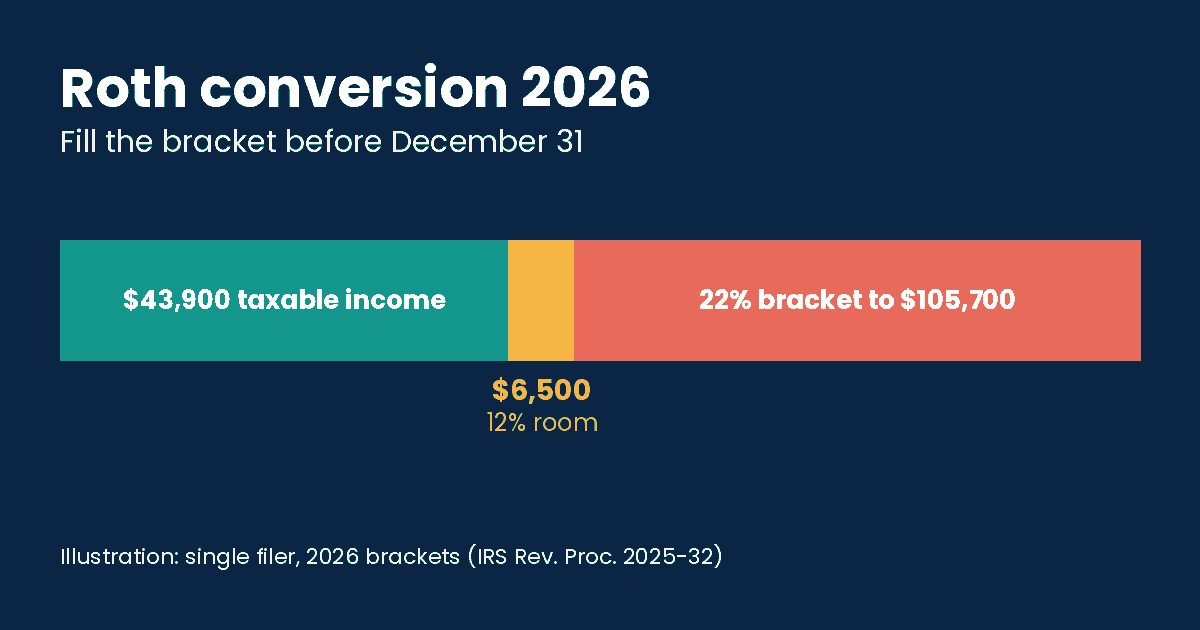
Table of contents
- What is a Roth conversion and how is it taxed?
- Why December 31 matters for a 2026 Roth conversion
- How to size a Roth conversion to your tax bracket
- The pro-rata rule when your IRA is not all pre-tax
- Costs beyond the bracket: Medicare, Social Security and more
- Where should the tax money come from?
- Rules to know before you convert
- When a Roth conversion can backfire
- Year-end Roth conversion checklist
- Common Roth conversion questions
- Sources reviewed
What is a Roth conversion and how is it taxed?
In a Roth conversion, you move pre-tax retirement money, most often from a traditional IRA, into a Roth IRA. You pay ordinary income tax on the pre-tax amount in the year of the conversion. In exchange, qualified withdrawals from the Roth IRA later are tax-free, and the original owner of a Roth IRA is not required to take distributions during life, according to the IRS.
The IRS describes three ways to do a Roth conversion: a 60-day rollover, a trustee-to-trustee transfer to a Roth IRA at a different institution, or a transfer between accounts at the same institution. The IRS states that a conversion results in taxation of any untaxed amounts in the traditional IRA, and that the conversion is reported on Form 8606.
Three features make a conversion different from most tax decisions:
- It is voluntary. Nobody forces you to convert, so you choose the year and the amount.
- It is added on top of your other income. The converted amount is taxed at your marginal rates, the same slices of income described in our 2026 tax brackets guide.
- It is final. The IRS says a conversion from a traditional, SEP or SIMPLE IRA to a Roth IRA cannot be recharacterized under rules effective January 1, 2018. Once you convert, you cannot change your mind next spring.
A conversion is also not the same thing as a contribution. Annual Roth contribution limits and income limits do not apply to the conversion itself. The 2026 IRA contribution limit is $7,500 across all your traditional and Roth IRAs, per the IRS, but you can convert far more than that if you are willing to pay the tax.
Why December 31 matters for a 2026 Roth conversion
A conversion counts for the tax year in which the money leaves the traditional IRA. A Roth conversion that is completed in 2026 is reported on your 2026 return, which you file in early 2027. A conversion requested in late December but not processed until January lands in 2027, with a different set of brackets and a different income picture.
That makes timing practical, not just legal. Custodians set their own cutoffs for transfers, and a trustee-to-trustee move between firms can take several business days. If you want the income in 2026, start the request well before the last week of the year and ask the custodian in writing what date it treats as the completion date.
There is a second reason to decide before year-end: the 2026 brackets are known today. The IRS had not published 2027 amounts when our brackets guide was written, so a 2026 Roth conversion can be sized against fixed numbers rather than estimates.
How to size a Roth conversion to your tax bracket
The most common method is often called “filling the bracket”: convert enough to use up the rest of the current bracket, and stop before the next, higher rate begins. The steps below use the 2026 IRS figures (Revenue Procedure 2025-32).
- Project your 2026 taxable income without the conversion. Take wages, interest, dividends, realized gains, pension and Social Security that is taxable, then subtract the standard deduction ($16,100 single, $32,200 married filing jointly, $24,150 head of household) or your itemized total.
- Find the top of your current bracket. Use the table below. The difference between that top and your projected taxable income is your bracket room.
- Decide how much of that room to use. Converting up to the bracket top costs the bracket’s rate on each dollar. Going past it moves the extra dollars into the next rate.
- Check the side effects. Confirm the converted amount does not trigger the costs described in the next sections before you commit.
- Set aside the tax. Know where the money for the tax will come from before you convert.
2026 bracket ceilings that matter most for conversions
| Rate | Single: taxable income up to | Married filing jointly: up to |
|---|---|---|
| 12% | $50,400 | $100,800 |
| 22% | $105,700 | $211,400 |
| 24% | $201,775 | $403,550 |
Source: IRS Revenue Procedure 2025-32 and IR-2025-103, as summarized in our tax brackets guide. The IRS notes that later legislation can change these amounts.
Worked example: single filer with $60,000 of wages
A single filer with $60,000 of wages and no other income takes the $16,100 standard deduction, leaving $43,900 of taxable income. The 12% bracket ends at $50,400, so there is $6,500 of room left at 12%. The 22% bracket then runs to $105,700, which is another $55,300.
| Amount converted | How it is taxed | Added federal income tax |
|---|---|---|
| $6,500 | All at 12% | $780 |
| $20,000 | $6,500 at 12% plus $13,500 at 22% | $3,750 |
| $40,000 | $6,500 at 12% plus $33,500 at 22% | $8,150 |
| $61,800 | $6,500 at 12% plus $55,300 at 22% | $12,946 |
These are hypothetical figures calculated from the 2026 brackets. They cover federal income tax only and ignore credits, state tax and the side effects discussed below. Notice that the last dollar of the $20,000 Roth conversion costs 22 cents while the first dollars cost 12 cents. The right amount depends on whether paying 22% now is likely to be better or worse than the rate you expect in retirement.
Worked example: married couple with $152,200 of wages
A married couple filing jointly with $152,200 of wages and the $32,200 standard deduction has $120,000 of taxable income. That is already in the 22% bracket, which ends at $211,400, so the couple has $91,400 of room before the 24% rate starts.
| Amount converted | How it is taxed | Added federal income tax |
|---|---|---|
| $50,000 | All at 22% | $11,000 |
| $91,400 | All at 22% | $20,108 |
| $100,000 | $91,400 at 22% plus $8,600 at 24% | $22,172 |
Same caveat: hypothetical, federal only. The couple’s decision is different from the single filer’s. They are not choosing between 12% and 22%. They are deciding whether paying 22% now beats the rate they might face when required minimum distributions begin, which our RMD deadline guide explains.
Why smaller conversions over several years often work better
Because brackets reset each January, a person with a large traditional IRA can convert a slice each year instead of one large amount. Each year’s Roth conversion is taxed at that year’s rates, which can avoid pushing a single year’s income into a much higher bracket. The tradeoff is that the process takes longer and relies on tax rules staying similar, which nobody can promise.
Years with temporarily low income are often the best candidates: a year between jobs, the early years of retirement before Social Security and RMDs begin, or a year with large deductions. If 2026 is a low-income year for you, the bracket room may be larger than the examples above.
The pro-rata rule when your IRA is not all pre-tax
If any of your traditional IRA money is after-tax (nondeductible contributions you reported on Form 8606), you cannot choose to convert only the after-tax dollars. The IRS instructions for Form 8606 count all of your traditional, SEP and SIMPLE IRAs together, using their total value at December 31, and the taxable share of a Roth conversion is based on the proportion of pre-tax money across that whole pool.
A simple example, using hypothetical numbers: you have one traditional IRA worth $100,000, of which $10,000 is after-tax basis and $90,000 is pre-tax. You convert $10,000. Because 90% of your total IRA money is pre-tax, about 90% of the conversion, or $9,000, is taxable, and $1,000 is a tax-free return of basis. Converting a different, smaller account does not change the math, because the accounts are treated as one.
Two practical points follow. First, keep your Form 8606 history, since it is the only record of your basis. Second, the year-end balance matters, so a large rollover into a traditional IRA late in the year can change the percentage. Because the calculation involves several lines on Form 8606, many people use tax software or a preparer for this step.
Costs beyond the bracket: Medicare, Social Security and more
The bracket math above is only the first layer. A Roth conversion raises your adjusted gross income for the year, and several other rules key off that number. Check each of these before you choose an amount.
Medicare premiums arrive two years later
The Social Security Administration’s operating manual says the income-related monthly adjustment amount (IRMAA), the surcharge on Medicare premiums for higher earners, generally uses tax return information from two years before the premium year. Its example is that 2026 premiums are generally based on 2024 return information. By the same logic, a conversion in 2026 would generally affect premiums for 2028.
If you are on Medicare now or will be by then, ask what a larger income year could do to your Part B and Part D premiums. Our Medicare Part D 2027 guide explains how plan costs are set. The IRMAA income thresholds for 2028 have not been published, so any dollar estimate today would be a guess.
The enhanced senior deduction can shrink
For tax years 2025 through 2028, people age 65 and older may claim an additional $6,000 deduction, up to $12,000 for a couple where both qualify. The IRS says the deduction begins to phase out above modified adjusted gross income of $75,000 for single filers and $150,000 for joint filers. A Roth conversion adds to that income, so a retiree near those lines could lose part of the deduction. The IRS page does not state the phase-out rate, so check the instructions for the exact amount lost before relying on a number.
More of your Social Security can become taxable
Taxable income from a conversion also counts when the IRS decides how much of your Social Security benefit is taxed. For someone already collecting benefits, a conversion can raise the taxable share of the benefit in the same year, which makes the effective cost of the conversion higher than the bracket rate suggests. IRS Publication 915 explains the formula.
Capital gains and other income can stack higher
Conversion income is counted before long-term capital gains are stacked on top. A filer who expected to sell investments at the 0% federal rate could find part of the gain pushed into the 15% rate. The 2026 thresholds are in our brackets guide.
State taxes and income-based benefits
Most states tax conversion income, though rules vary and a few states have no income tax. If you plan to move to a state with no income tax, waiting until after the move could change the math. Premium subsidies for marketplace health coverage and other benefits that depend on income can also be affected. Check the rules for any benefit you receive before converting.
Where should the tax money come from?
You can pay the tax on a Roth conversion from the converted money itself or from other savings. Paying from outside the IRA is usually the cleaner approach, because every converted dollar then ends up in the Roth account. Paying from the converted money shrinks the amount that moves over. And if you are younger than 59½, money withheld from the conversion to pay tax is treated as a withdrawal, and the 10% additional tax on early distributions can apply to it unless an exception covers it. That is a good reason to avoid having tax withheld from a conversion at all.
Here is a hypothetical comparison that shows what a conversion does and does not do. Suppose you convert $20,000 at a 22% rate, paying $4,400 of tax from a savings account, and everything grows at 6% a year for 20 years. This is a simplified illustration, not a forecast, and it ignores taxes on the savings account’s earnings.
| Convert now | Do not convert | |
|---|---|---|
| Retirement account after 20 years | $64,143 in the Roth IRA, tax-free | $64,143 in the traditional IRA |
| Tax due when withdrawn at 22% | $0 | $14,111 |
| After-tax value of the IRA | $64,143 | $50,031 |
| Value of the $4,400 left in savings | $0 (it paid the tax) | $14,111 |
| Total after-tax value | $64,143 | $64,142 |
The two paths come out essentially even. That is the point worth understanding: if your tax rate in retirement equals your rate today, a Roth conversion does not create a gain by itself. The benefit comes from other things: paying tax at a lower rate now than later, tax-free growth on earnings the savings account would have paid tax on, flexibility from avoiding RMDs on Roth money, and leaving heirs money without income tax on qualified withdrawals. The cost is losing the option to keep the tax payment as liquid savings. If you will need that cash, keep it somewhere safe and accessible; our guide to high-yield savings versus CDs compares options.
Rules to know before you convert
You cannot undo a Roth conversion
The IRS says conversions made in 2018 or later cannot be recharacterized as a contribution to a traditional IRA. Treat every conversion as permanent, and size it conservatively if you are unsure about your income for the rest of the year. A bonus, a stock sale or a spouse’s income that arrives after you convert can push the total higher than planned, and you cannot reverse the conversion.
Required distributions come first
An IRS presentation on Roth conversions states that required minimum distributions cannot be rolled over, which means the RMD for the year must be taken as a distribution before the rest of the account is converted. The presentation dates from 2010, so confirm the current rule with your custodian or a tax professional if you are subject to RMDs. See our RMD deadline guide for how that amount is calculated.
The five-year rules
Two different five-year periods exist, and people often mix them up. One governs whether withdrawals of Roth earnings are qualified and therefore tax-free; the IRS says it is measured from January 1 of the year you first made a Roth IRA contribution, and conversions count.
The other concerns the 10% additional tax on early withdrawal of converted amounts: if you are under 59½ and withdraw converted money within five years of the conversion, the 10% tax can apply to the portion that was taxable at conversion, unless an exception applies. Each conversion has its own five-year period. Publication 590-B has a section on distributions of conversion contributions within the five-year period; read it before you take money out of a Roth IRA within a few years of converting.
Withdrawal order inside a Roth IRA
Roth IRA distributions come out in a set order: contributions first, then conversions, then earnings. That order is why a person under 59½ can often withdraw regular Roth contributions without tax or penalty, while converted money and earnings face the rules above. Pub. 590-B covers the ordering rules in detail.
Inherited Roth IRAs
A Roth IRA can be a way to leave money to heirs without income tax on qualified withdrawals, but most non-spouse beneficiaries must empty an inherited account within ten years under current law. Rules for beneficiaries are complicated, so estate planning questions are worth taking to a qualified adviser.
When a Roth conversion can backfire
A Roth conversion is a bet about future tax rates and a commitment of cash today. It tends to work less well in these situations:
- You expect a lower tax rate later. If you are in a high bracket now and expect much lower income in retirement, paying tax today may cost more than paying tax on withdrawals later.
- You would have to use the IRA to pay the tax. Paying from the converted amount shrinks the benefit, and early-withdrawal tax can apply under 59½.
- The extra income crosses a threshold. A Roth conversion that costs you the senior deduction, raises the taxable share of Social Security or triggers higher Medicare premiums can cost far more than the bracket math suggests.
- You may need the money soon. Converted funds are subject to the five-year rule if you are under 59½, so the money is less flexible for the next several years.
- Your income is uncertain. Because you cannot undo a conversion, an unpredictable year argues for a smaller amount.
- You plan to give the IRA to charity. Money left to a charity from a traditional IRA is generally not taxed to the charity, so converting it first may waste tax dollars.
Year-end Roth conversion checklist
- Estimate your 2026 taxable income, including bonuses, investment sales and a spouse’s income.
- Calculate your bracket room using the 2026 figures above.
- Gather Form 8606 records and the December 31 balances of every traditional, SEP and SIMPLE IRA you own, if you have after-tax money.
- Take any required minimum distribution for 2026 first, if one applies.
- Check the side effects: the senior deduction, Social Security taxation, Medicare premiums two years out, capital gains and state tax.
- Decide the Roth conversion amount, and decide where the tax money will come from.
- Ask your custodian for the exact deadline to complete the conversion in 2026, and submit the request early.
- Do not withhold tax from the conversion if you are under 59½.
- After the conversion, save the confirmation. Expect Form 1099-R from the custodian in early 2027, and make sure Form 8606 is filed with your return.
- Consider whether a higher 2026 income calls for adjusting withholding or making an estimated tax payment. A tax professional can tell you how.
Common Roth conversion questions
Is there an income limit for a Roth conversion?
No. The income limits that apply to Roth IRA contributions do not apply to conversions, according to IRS materials. Anyone with a traditional IRA can convert, though the tax on the conversion can be large at high income.
Can I convert only part of my IRA?
Yes. You choose the amount, and many people convert in slices across several years. If you have after-tax money in any traditional IRA, the pro-rata rule decides how much of each Roth conversion is taxable.
Can I reverse a Roth conversion if my income turns out higher than expected?
No. The IRS says conversions made in 2018 or later cannot be recharacterized. That is why a cautious amount is often better than a maximum one.
Is a Roth conversion the same as a backdoor Roth?
They use the same mechanism, but the purpose differs. A backdoor Roth is a strategy for people whose income is too high to contribute to a Roth IRA directly. It involves a nondeductible traditional IRA contribution followed by a conversion, and the pro-rata rule applies to it. This guide covers converting existing pre-tax IRA money.
Do I have to wait five years to use converted money?
Not necessarily. Converted amounts can generally be withdrawn tax-free, since you already paid tax on them, but the 10% additional tax can apply to converted amounts withdrawn within five years if you are under 59½, with exceptions. After 59½, the rule for converted principal no longer applies, though the separate five-year rule for earnings still matters.
Educational disclaimer
This article is general financial education, not tax, legal or investment advice. FinovativeHub is not a tax preparer or financial adviser. Roth conversion outcomes depend on your income, state, age, benefits and future law, which can change. The examples use hypothetical numbers and 2026 federal rules. Confirm your situation with the IRS or a qualified tax professional before converting.
Sources reviewed
- IRS, Retirement plans FAQs regarding IRAs (conversion methods, taxation of untaxed amounts, no recharacterization after 2017, Form 8606; page last reviewed November 16, 2025; checked October 26, 2026)
- IRS, Instructions for Form 8606 (2025) (traditional, SEP and SIMPLE IRAs counted together at December 31; checked October 26, 2026)
- IRS, Roth IRAs (page last reviewed August 9, 2026; checked October 26, 2026)
- IRS, Retirement topics: IRA contribution limits ($7,500 for 2026; page last reviewed September 23, 2026; checked October 26, 2026)
- IRS, Check your eligibility for the new enhanced deduction for seniors ($6,000 deduction, 2025 through 2028, phase-out thresholds; page last reviewed September 21, 2026; checked October 26, 2026)
- IRS, Publication 590-B (2025), Distributions from Individual Retirement Arrangements (section headings on conversions within the five-year period and ordering rules; checked October 26, 2026)
- IRS Nationwide Tax Forum presentation, Roth Conversions (2010) (RMDs cannot be rolled over; no income limit on conversions; dated source, confirm current rules)
- Social Security Administration, POMS HI 01101.010, Modified Adjusted Gross Income (IRMAA generally uses information from two years earlier; checked October 26, 2026)
- IRS, Revenue Procedure 2025-32 and IR-2025-103 (2026 brackets and standard deduction, as summarized in our brackets guide)

FinovativeHub Editorial Team publishes personal finance guides for American readers, covering budgeting, credit cards, loans, and retirement accounts. We aim to explain how things work in plain English and to cite official sources, such as the IRS, where they apply. Rates, fees, and limits change, so confirm current terms with the provider or agency before you act.