The RMD deadline for 2026 is December 31, 2026 for most people who already take required minimum distributions. If you turn 73 this year, you get one extra option: you may take your first RMD by December 31, 2026 or delay it until April 1, 2027, though delaying means two taxable withdrawals in 2027. Missing the deadline can trigger a 25% excise tax on the amount you should have withdrawn, so it pays to know your number before the year ends.
This guide explains who owes an RMD, how to calculate one with the IRS Uniform Lifetime Table, how the rules differ across IRAs, 401(k)s and 403(b)s, and what to do if you miss the deadline. Every rule below was checked against IRS and FINRA pages on October 25, 2026, and the dollar examples are hypothetical so you can follow the math with your own balances.
In this guide
- RMD deadline 2026: the dates that matter
- Who has to take a required minimum distribution?
- How to calculate your 2026 RMD
- How RMDs work with more than one account
- What if you are still working?
- Your first RMD and the double-distribution trap
- Do Roth accounts have RMDs?
- What happens if you miss the deadline
- Using a qualified charitable distribution
- Inherited accounts
- Common RMD mistakes to avoid
- A year-end RMD checklist
- Questions people ask about RMDs
- Sources reviewed
RMD deadline 2026: the dates that matter
A required minimum distribution is the smallest amount the IRS requires you to withdraw each year from most tax-deferred retirement accounts once you reach the starting age. The rules the IRS describes on its required minimum distributions page (last reviewed April 8, 2026) set the starting age at 73 for most current retirees.
Two separate deadlines exist, and mixing them up is the most common mistake.
| Situation | Deadline | What it covers |
|---|---|---|
| You turn 73 in 2026 (first RMD) | December 31, 2026, or delay to April 1, 2027 | Your 2026 RMD |
| You turned 73 in 2025 and delayed your first RMD | April 1, 2026 has passed; the second RMD is due December 31, 2026 | Your 2026 RMD |
| You are 74 or older | December 31, 2026 | Your 2026 RMD |
| You turn 73 in 2027 or later | Not due in 2026 | No 2026 RMD yet |
December 31, 2026 falls on a Thursday, which leaves about nine weeks from today. Custodians often need several business days to process a withdrawal, and the last week of December is busy, so waiting for the final days adds avoidable risk. Ask your account provider for its own cutoff date for year-end requests.
Who has to take a required minimum distribution?
You generally owe an RMD if you own a tax-deferred retirement account and have reached the starting age. The IRS lists traditional IRAs, SEP IRAs, SIMPLE IRAs, 401(k) plans, 403(b) plans, 457(b) plans and profit-sharing plans among the accounts covered.
The starting age depends on your birth year. People who turned 73 or older can rely on the IRS statement that most account owners begin at 73. Under the SECURE 2.0 Act, a later starting age of 75 is scheduled for people born in 1960 or later, according to a Nasdaq explainer we reviewed (the IRS page we checked lists only age 73). That group turns 66 in 2026, so it does not affect this year’s deadline. If you were born before 1951, your starting age was different and you have likely been taking RMDs for years.
A quick way to test yourself: if you were born in 1953 or earlier and hold a traditional IRA or an employer plan balance, you probably owe a 2026 RMD. If you were born in 1954 or later, you probably do not yet. Because plan rules and birth-year edge cases vary, confirm with your custodian or a tax professional.
How to calculate your 2026 RMD
The IRS formula has two inputs. As the IRS retirement plan FAQs explain, you divide the prior December 31 balance of the account by a life expectancy factor from the IRS tables in Publication 590-B. For a 2026 RMD, that means your balance on December 31, 2025.
Step 1: Find your December 31, 2025 balance
Use the year-end statement for each IRA or plan account. Your custodian must report the value or offer to calculate your RMD, and FINRA notes you can verify the figure with an RMD calculator.
Step 2: Find your factor
Most owners use the Uniform Lifetime Table (Table III). The exception is an owner whose sole beneficiary is a spouse more than 10 years younger, who uses the Joint Life and Last Survivor Expectancy Table (Table II). Two Table III factors are confirmed in IRS Publication 590-B’s examples: 26.5 at age 73 and 24.6 at age 75. Look up other ages in Publication 590-B, Appendix B.
Step 3: Divide
Divide the balance by the factor. The result is the minimum for that account.
| Hypothetical owner | Dec. 31, 2025 balance | IRS factor | 2026 RMD |
|---|---|---|---|
| Age 73 | $400,000 | 26.5 | $15,094 |
| Age 75 | $650,000 | 24.6 | $26,423 |
Both figures are rounded to the nearest dollar, and the balances are invented for illustration. Your age for the factor is the age you reach in 2026, not your age on December 31, 2025.
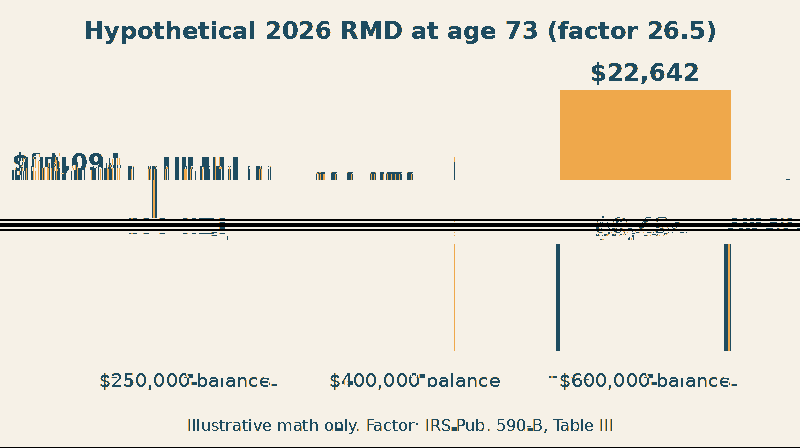
Notice what the formula does and does not do. The RMD rises with your balance and, as the factor gets smaller with age, with each year you get older. It does not depend on market performance during 2026, because it uses a balance that is already fixed. A strong or weak year for markets changes next year’s RMD, not this one.
Taking more than the minimum
You can withdraw more than the RMD, but the IRS FAQs state that an excess in one year cannot be applied to a future year’s RMD. Withdrawals above the minimum are also generally taxable as ordinary income unless they are nontaxable, such as qualified Roth distributions. Taking more only makes sense if you need the cash or have a deliberate tax-planning reason.
Is an RMD taxable?
Usually yes. The IRS says withdrawals are taxable income, except for basis and qualified distributions from designated Roth accounts. A large RMD can raise your taxable income for the year, so it helps to compare it with the 2026 federal tax brackets and standard deduction before you decide how much, if any, to withhold. Ask your custodian how to set federal withholding on the distribution.
How RMDs work with more than one account
Rules for combining accounts differ by account type, and the difference matters if you hold several.
| Account type | How the RMD is calculated and taken |
|---|---|
| Traditional, SEP and SIMPLE IRAs | Calculate each IRA separately, then you may take the total from one or more of them |
| 403(b) contracts | Calculate each contract separately; the total can come from one or more |
| 401(k) and 457(b) plans | Calculate and take the RMD separately from each plan |
That summary comes from the IRS retirement plan FAQs and the IRS RMD comparison chart (reviewed December 10, 2025). The IRA rule and the 401(k) rule do not mix: an IRA withdrawal cannot satisfy a 401(k) RMD, and the reverse is also true.
Worked example with two IRAs and a 401(k)
Suppose a 73-year-old has IRA A with $250,000, IRA B with $150,000 and a 401(k) with $200,000 on December 31, 2025. At 26.5, the RMDs are:
- IRA A: $250,000 ÷ 26.5 = $9,434
- IRA B: $150,000 ÷ 26.5 = $5,660
- 401(k): $200,000 ÷ 26.5 = $7,547
The two IRA amounts total $15,094, and the owner may take that whole amount from IRA A, from IRA B or any split between them. The $7,547 for the 401(k) must come out of the 401(k) itself. Required withdrawals across the three accounts add up to $22,641. Dividing the combined $600,000 once gives $22,642, and the one-dollar difference is rounding.
This is why people consolidating old accounts sometimes simplify their lives: fewer accounts means fewer calculations. Rolling a pre-RMD balance into an IRA is a separate decision with its own tax and fee considerations, and an RMD amount itself cannot be rolled over.
What if you are still working?
The still-working exception is narrower than many people assume. According to the IRS, workplace plan participants can delay RMDs from the plan they are currently working for until the year they retire, if the plan allows it, unless they own 5% or more of the sponsoring business. The exception does not apply to IRAs. Traditional, SEP and SIMPLE IRA owners must begin at the starting age even while employed.
Two practical consequences follow. First, an older worker with a current 401(k) and a rollover IRA from a previous job may owe an RMD on the IRA but not on the current employer plan. Second, the delay depends on plan rules, so ask your plan administrator for the plan’s terms in writing before assuming you qualify.
Your first RMD and the double-distribution trap
Your first RMD is the one with the flexible deadline. You may take it in the year you turn 73, or wait until April 1 of the following year. Every later RMD is due by December 31.
Delaying looks appealing because it pushes income into the next year, but the trap is that your second RMD, for the year after you turn 73, is still due December 31 of that year. Both distributions then land in the same tax year.
For someone who turns 73 in 2026, the timeline looks like this:
- Option A: take the 2026 RMD by December 31, 2026 and the 2027 RMD by December 31, 2027. One distribution is taxed in each year.
- Option B: take the 2026 RMD by April 1, 2027 and the 2027 RMD by December 31, 2027. Both are taxed in 2027.
With Option B, a hypothetical owner with a $15,094 RMD for 2026 would add that amount to the 2027 RMD (calculated from the December 31, 2026 balance and the factor for age 74). The combined income could push part of it into a higher bracket than splitting it across two years would. It could also matter for other income-based rules, which is a good reason to run both options past a tax professional. Option B can still be right if you expect much lower income in 2027, such as the year after you stop working.
Do Roth accounts have RMDs?
Not for the original owner. The IRS states that Roth IRA owners and owners of designated Roth accounts in 401(k) or 403(b) plans do not take RMDs while alive. FINRA’s guidance says the same. Beneficiaries who inherit a Roth IRA are subject to RMD rules.
What happens if you miss the RMD deadline
The IRS charges a 25% excise tax on the amount you did not withdraw. If you correct the shortfall within two years, the rate drops to 10%. You report the shortfall on Form 5329 with your tax return for the year the RMD was required.
Here is a hypothetical. A 73-year-old owed $15,094 and withdrew only $9,000, leaving a $6,094 shortfall:
- Penalty at 25%: $6,094 × 0.25 = $1,523.50
- Penalty if corrected within two years at 10%: $6,094 × 0.10 = $609.40
The penalty applies only to the missing portion, not to the whole RMD. The IRS also notes the penalty may be waived for a reasonable error if reasonable steps are being taken to remedy the shortfall, with a letter of explanation attached to Form 5329. A waiver is not automatic, so withdraw the missed amount as soon as you notice, then consult a tax professional about the filing.
Using a qualified charitable distribution to meet your RMD
A qualified charitable distribution (QCD) is a direct transfer from an IRA to an eligible charity. According to a Congressional Research Service report dated January 15, 2026, you must be at least 70½ when the QCD is made, the 2026 annual limit is $111,000 (up from $108,000 in 2025), and a QCD can satisfy all or part of your RMD.
The same report gives this illustration: a $3,000 QCD against a $5,000 RMD leaves $2,000 to be withdrawn as ordinary taxable income. Several limits apply:
- The money must go straight from the IRA custodian to the charity, not through your hands.
- QCDs come from traditional IRAs. They cannot come from ongoing SEP or SIMPLE IRAs, or from 401(k) or 403(b) plans.
- The charity must be eligible to receive tax-deductible contributions.
Because timing matters, ask your custodian how long a QCD takes to reach the charity. A check that is still in the mail on December 31 may not count toward the 2026 RMD. A QCD is a tax-planning tool, not a reason to give more than you intended, and your tax professional can tell you how it interacts with your own situation.
Inherited accounts follow different rules
If you inherited a retirement account, your RMD rules depend on who left it to you and when. The IRS FAQs say that for owners who died after December 31, 2019, the entire balance generally must be distributed within ten years, with exceptions for certain beneficiaries such as a surviving spouse. Inherited accounts use the Single Life Table rather than the Uniform Lifetime Table. Because the rules branch quickly, treat inherited accounts as a separate project and get account-specific guidance.
Common RMD mistakes to avoid
Most RMD penalties come from a handful of repeat errors rather than from complicated tax law. Watch for these:
- Using the wrong balance. The 2026 RMD uses the December 31, 2025 balance, not today’s balance.
- Forgetting an old account. A 401(k) left with a former employer still counts, and its RMD is calculated separately.
- Mixing account types. Taking an IRA withdrawal does not satisfy a 401(k) RMD, even if the dollar amounts match.
- Assuming a rollover counts. An RMD cannot be rolled over, so a transfer to another retirement account does not satisfy it.
- Delaying the first RMD without a plan. The April 1 option is useful only if the double distribution in the next year fits your tax picture.
- Waiting until the last week. A custodian cutoff, a holiday or a system problem can turn a small delay into a missed deadline.
A year-end RMD checklist
- Confirm your age and birth year. Decide whether 2026 is your first RMD year, a later year or not yet due.
- List every account. Include old 401(k)s, 403(b)s and IRAs you forgot about.
- Pull December 31, 2025 balances. Use year-end statements.
- Find each factor. Use Publication 590-B, Table III, unless your sole beneficiary is a spouse more than 10 years younger.
- Divide and add up. Keep IRAs together and 401(k)s separate.
- Check what you have already withdrawn in 2026. Regular monthly withdrawals count toward the RMD.
- Decide on withholding and taxes. Compare the total against your expected 2026 tax picture.
- Consider a QCD if you already give to charity and are 70½ or older.
- Submit the request early. Ask your custodian for its year-end cutoff.
- Save the confirmation. Keep the statement showing the withdrawal date and amount.
If you are also reviewing contribution limits and year-end moves, our guide to the 2026 401(k) and IRA contribution limits covers the other side of retirement accounts, and the personal finance in 2026 overview puts year-end planning in context. Readers approaching Medicare may also want the Medicare Part D 2027 guide, since retirement income and health coverage choices often land in the same season.
Questions people ask about RMDs
Can I roll my RMD into another retirement account?
No. The IRS FAQs state that RMD amounts cannot be rolled over into another tax-deferred account.
If I take extra this year, can I skip next year’s RMD?
No. An excess withdrawal in one year does not reduce a later year’s RMD, according to both the IRS and FINRA.
Does my custodian calculate the RMD for me?
FINRA says your IRA custodian must report your RMD amount or offer to calculate it. You remain responsible for taking it on time, so check the number against your own math.
Do I owe an RMD from a Roth IRA?
Not as the original owner. Beneficiaries of Roth IRAs do have RMD requirements.
What if I turned 73 in 2025 and have not taken any RMD yet?
Your first RMD, for 2025, was due April 1, 2026, and your second, for 2026, is due December 31, 2026. If the first was missed, withdraw it now and speak with a tax professional about Form 5329 and a possible waiver.
Educational disclaimer
This article is general financial education for US readers and is not tax, legal or investment advice. Rules and IRS tables can change, your situation may differ, and the dollar examples are hypothetical. Confirm your RMD with your account provider and a qualified tax professional before acting. The editorial team has not independently reviewed any individual account.
Sources reviewed
All sources were opened and read on October 25, 2026, unless noted. We could not fetch the full Uniform Lifetime Table, so only the 73 and 75 factors that IRS Publication 590-B prints in its examples are used here.
- IRS: Retirement topics, required minimum distributions (page reviewed April 8, 2026)
- IRS: Retirement plan and IRA required minimum distributions FAQs (page reviewed January 29, 2026)
- IRS: RMD comparison chart, IRAs vs. defined contribution plans (page reviewed December 10, 2025)
- IRS Publication 590-B (2025), Distributions from IRAs (factor examples for ages 73 and 75)
- FINRA: Required minimum distributions, know your deadlines (published January 22, 2025)
- Congressional Research Service: Qualified charitable distributions from IRAs (January 15, 2026)
- Nasdaq: RMD changes explainer (secondary source, used only for the age-75 scheduling note and penalty history)

FinovativeHub Editorial Team publishes personal finance guides for American readers, covering budgeting, credit cards, loans, and retirement accounts. We aim to explain how things work in plain English and to cite official sources, such as the IRS, where they apply. Rates, fees, and limits change, so confirm current terms with the provider or agency before you act.