The charitable deduction works differently in 2026 than it did in 2025. For the first time, people who take the standard deduction can deduct up to $1,000 of cash gifts to charity ($2,000 on a joint return). People who itemize face two new limits: a floor equal to 0.5% of adjusted gross income (AGI) and a cap on the tax value of the deduction for top-bracket taxpayers. Gifts must be made by December 31, 2026 to count on the return you file in early 2027.
This guide explains each change to the charitable deduction with worked examples, shows how to decide between the standard deduction and itemizing, tests whether “bunching” gifts still pays, and ends with a year-end checklist. The IRS describes the basic rules on its Topic 506 charitable contributions page, which it last updated on September 24, 2026.
What changed in the charitable deduction for 2026?
Four rules shape the charitable deduction this year. One is new for standard-deduction filers, two are new limits on itemizers and top-bracket taxpayers, and one is a rule that many donors assumed would shrink but did not. The table shows who each rule affects.
| Rule for 2026 | Who it affects | What it does |
|---|---|---|
| Non-itemizer deduction | Standard deduction filers | Up to $1,000 ($2,000 joint) of cash gifts to qualified charities |
| 0.5% of AGI floor | Itemizers | Only giving above 0.5% of AGI is deductible |
| 35% cap on value | Taxpayers in the 37% bracket | Deductions save 35 cents per dollar instead of 37 |
| 60% of AGI cash limit | Itemizers giving cash to public charities | Stays at 60% rather than dropping to 50% |
The IRS Topic 506 page confirms the first row directly. The other three rows come from the 2025 tax law as described by secondary sources: Kiplinger, Regions Bank and a National Tax Tools guide that cites the Internal Revenue Code sections. We checked them on October 27, 2026 and found them consistent on the amounts, but we could not open the IRS form instructions for 2026 that would spell out the arithmetic. Treat those three rules as well supported but worth confirming against the 2026 Schedule A instructions when the IRS publishes them.
The new charitable deduction if you take the standard deduction
Most households take the standard deduction, which for 2026 is $16,100 for a single filer and $32,200 for a married couple filing jointly (see our 2026 tax brackets and standard deduction guide for the full table). Until now, charitable gifts did nothing for those households unless their itemized total beat the standard deduction.
For tax year 2026, the charitable deduction is open to non-itemizers for the first time. The IRS says they may deduct up to $1,000 of cash gifts to certain qualified organizations, or $2,000 on a joint return. This deduction is in addition to the standard deduction.
Which gifts qualify
The details come from the secondary sources above, and all agree on the following points:
- Cash only. Checks, debit and credit card gifts, online donations and payroll giving count as cash. Donated clothing, furniture, a car or appreciated stock does not.
- Public charities. The gift must go to a qualifying 501(c)(3) public charity. Gifts to a donor-advised fund or a private foundation do not qualify for this particular deduction.
- No carryforward. If you give $3,000 and your limit is $1,000, the extra $2,000 cannot be saved for next year under this rule.
- No floor. The 0.5% floor described below applies to itemizers, not to this deduction.
One detail is not settled across the sources we read. Regions describes the deduction as reducing AGI, while National Tax Tools says it does not. The question matters for income-based phase-outs and thresholds, so check the 2026 Form 1040 instructions rather than relying on either description.
Worked example: what the $1,000 charitable deduction is worth
A single filer has $60,000 of taxable income after the standard deduction and gives $1,500 in cash to a food bank. Only $1,000 is deductible. Using the 2026 brackets in our tax guide, that filer is in the 22% bracket, so the $1,000 deduction lowers federal income tax by about $220. A filer whose top dollars fall in the 12% bracket saves about $120. Either way the saving is a fraction of the gift, which is a reason to give for the cause, not the tax result.
A married couple filing jointly who give $3,000 in cash can take a $2,000 charitable deduction. In the 12% bracket that is about $240 of federal tax; in the 22% bracket, about $440. The examples are hypothetical and ignore state tax.
The 0.5% floor on the charitable deduction if you itemize
If you itemize on Schedule A, the first slice of your giving no longer counts toward the charitable deduction. For 2026, only giving above 0.5% of your AGI is deductible. Kiplinger’s example: with $200,000 of AGI and $2,000 of donations, the floor is $1,000, so $1,000 is deductible.
The floor is a threshold, not a percentage haircut. Think of it as a deductible on a charitable-giving “policy.” The first dollars you give each year are not rewarded, and every dollar above the line is.
Worked example: the floor in dollars
A single filer has $120,000 of AGI, $12,000 of other itemized deductions and gives $5,000 in cash.
- Floor: 0.5% of $120,000 = $600.
- Deductible giving: $5,000 minus $600 = $4,400.
- Total itemized deductions: $12,000 plus $4,400 = $16,400.
- Taxable income is about $103,600 ($120,000 minus $16,400), which falls in the 22% bracket. The charitable portion lowers tax by about $968. Under the earlier rules, with no floor, the same gift would have been worth about $1,100.
The floor costs this filer about $132 of tax. Higher earners lose more, because 0.5% of a larger AGI is a larger number. National Tax Tools notes that the floor does not carry over, so the disallowed amount is lost. The same source says the floor is applied first to the least favorable categories of gifts, which generally preserves the cash deduction. We have not confirmed that ordering against the statute text.
If you are carrying forward gifts from earlier years, be careful. Kiplinger warns that carryforwards used in 2026 and later are subject to the new limits, so a 2025 gift carried into 2026 may produce less benefit than you expected.
The 35% cap for the top bracket
Taxpayers in the 37% bracket generally receive a tax benefit of 35 cents per dollar of itemized deductions, including charitable gifts, rather than 37 cents. The deduction amount is unchanged; the cap limits what the deduction is worth. In 2026, the 37% bracket begins above $640,600 of taxable income for single filers and $768,700 for joint filers (figures from our brackets guide), so this rule affects a small group of households.
Kiplinger’s example: a $2,000 deductible gift saves $700 in 2026 instead of $740. The arithmetic is simple, but the interaction with the floor is not, and we have not independently confirmed the order in which the two rules are applied. Anyone at this income level should have a tax professional run both.
What did not change in the charitable deduction
- The 60% limit. Cash gifts to public charities remain deductible up to 60% of AGI. Regions says the limit still applies, and National Tax Tools says the 2025 law made it permanent instead of letting it fall to 50%. Few households give anywhere near 60% of income.
- Appreciated assets. Long-term appreciated property given to public charities is generally deductible at fair market value up to 30% of AGI, according to National Tax Tools. This benefit is for itemizers only.
- Five-year carryover. Amounts above the applicable AGI limit can carry forward for up to five years, with each gift keeping its category.
- Qualified organizations. IRS Publication 526 lists churches, nonprofit schools and hospitals, the Red Cross and United Way as examples, and says civic leagues, social clubs, labor unions, chambers of commerce, homeowners’ associations, political groups and individuals do not qualify.
- Noncash rules. Per IRS Topic 506, you can generally deduct the fair market value of donated property to a qualified organization, and a deduction over $500 requires Form 8283.
Standard deduction or itemizing: a worked comparison
With a $1,000 charitable deduction available even without itemizing, the break-even point has shifted. Itemizing now needs to beat the standard deduction plus the non-itemizer deduction, not just the standard deduction.
Worked example: single filer, $90,000 AGI
Suppose a single filer has $12,000 of other itemized deductions (for example, state and local taxes and mortgage interest) and gives $5,000 in cash.
| Option | How it is calculated | Total deductions |
|---|---|---|
| Standard deduction plus $1,000 | $16,100 + $1,000 | $17,100 |
| Itemize | $12,000 + ($5,000 minus $450 floor) | $16,550 |
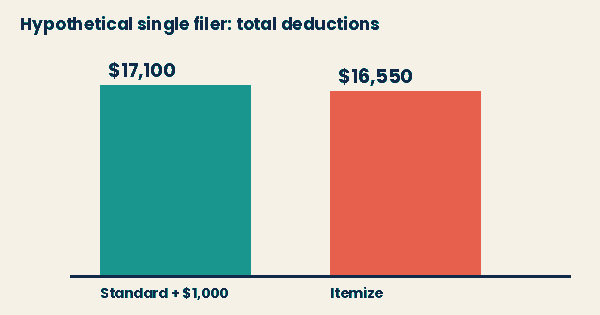
In this case, taking the standard deduction wins by $550, even though the filer gave $5,000. Under the old rules the comparison would have been $16,100 against $17,000, and itemizing would have won. The new non-itemizer deduction is the reason the answer changed. The point is not that giving is pointless; it is that the form you use determines how much of the gift is recognized.
To run the comparison yourself, add up everything you would itemize, subtract 0.5% of AGI from your charitable total, and compare the sum to your standard deduction plus the lesser of your cash gifts or $1,000 ($2,000 if married filing jointly). Tax software or a preparer can do this in minutes, and it is worth doing before December 31 while you can still change your giving.
Does bunching gifts still work?
Bunching means concentrating several years of giving into one year to get more from the charitable deduction, so that you itemize in that year and take the standard deduction in the others. It is commonly suggested when itemized deductions sit just below the standard deduction. In 2026 the new rules weaken the case, because a small giver now gets a deduction every year without bunching.
Worked example: $4,000 a year versus $8,000 once
A single filer has $100,000 of AGI, $11,000 of other itemized deductions and plans to give $8,000 over two years. The floor is $500.
| Plan | Year 1 | Year 2 | Two-year deductions |
|---|---|---|---|
| Give $4,000 each year | Standard: $16,100 + $1,000 = $17,100 | Same: $17,100 | $34,200 |
| Give $8,000 in year 1, nothing in year 2 | Itemize: $11,000 + $7,500 = $18,500 | Standard: $16,100 | $34,600 |
Bunching adds $400 of deductions across two years, which at a 22% bracket is about $88 of federal tax. In the $4,000-a-year plan, itemizing would give only $14,500 ($11,000 plus $3,500 after the floor), so the filer correctly takes the standard deduction plus the $1,000.
The result also depends on the amount. If the same filer bunched only $6,000, itemizing would total $16,500, which is less than the $17,100 from the standard deduction plus $1,000, and bunching would lose. The lesson is to run the numbers for your own case, since the benefit is modest and the downside is real. A donor-advised fund is a common tool for bunching because you can deduct a large contribution in one year and recommend grants to charities later, but gifts to a donor-advised fund do not qualify for the non-itemizer deduction, so they only help in a year you itemize.
All figures here are hypothetical and ignore state tax, the senior deduction and other rules that can change the answer.
Giving from an IRA with a qualified charitable distribution
People age 70½ or older can send money directly from an IRA to a qualified charity. This is a qualified charitable distribution, or QCD. The amount is generally not counted as taxable income, and it is not claimed as a charitable deduction on Schedule A. For 2026, a Des Moines community foundation article puts the annual limit at $111,000 per person, up from $108,000 (a secondary source; confirm the figure with your IRA custodian). It also notes that QCDs to donor-advised funds are not eligible.
Both Kiplinger and Regions say the 0.5% floor does not affect QCDs. That is useful for retirees who take the standard deduction, because a QCD lowers taxable income without needing to itemize. QCDs can generally also count toward your required minimum distribution, so confirm the rules for your account with your custodian. Our RMD deadline guide explains how to calculate the amount you owe by December 31, and our Roth conversion guide covers how a conversion can affect the same tax year.
Two cautions apply. IRS Publication 526 states that a QCD is generally not deductible as a charitable contribution, so you cannot claim the same dollars twice. And the money has to move from the IRA to the charity; withdrawing it yourself and writing a check does not make it a QCD.
What counts as a deductible gift, and what records to keep
Qualified organizations only
IRS Topic 506 says gifts to individuals are not deductible and that only qualified organizations can receive tax-deductible contributions. That excludes most crowdfunding campaigns for a specific person, no matter how worthy. The IRS Tax Exempt Organization Search tool, described on the Topic 506 page, lets you confirm an organization’s status by name or EIN.
Publication 526 also lists items that are not deductible: the value of your time or services, raffle, bingo and lottery tickets, tuition, and personal expenses. If you receive something in return, such as a dinner or a gift, you can deduct only the amount above the fair market value of what you received.
Records the IRS expects
- Any cash gift, any amount: a bank record or a written communication from the charity showing its name, the amount and the date.
- $250 or more: a written acknowledgment from the charity, received before you file, stating the amount, whether you received goods or services, and their estimated value if so.
- Noncash gifts over $500: Form 8283. Items over $5,000 generally require a qualified appraisal.
One document can satisfy both the bank-record rule and the $250 rule. The simplest habit is to save each receipt in one folder as you give, rather than gathering them in April.
Timing: December 31 and Giving Tuesday
The IRS Taxpayer Advocate Service notes that donations count toward a given tax year only if they are made by the end of that year. A gift made on January 2, 2027 belongs to your 2027 return. Giving Tuesday, which falls on the Tuesday after Thanksgiving, is December 1 in 2026, leaving four weeks after it to finish.
Do not leave the last step to the final day. Online processors, payroll cycles and mail all take time, and a charity can only acknowledge a gift it has received. If a gift is close to the deadline, ask the charity how it dates gifts, and keep the confirmation.
If your giving is tied to holiday spending, the same planning discipline applies. Our holiday budget guide shows one way to set a total and fund it weekly so that generosity does not turn into January debt.
A year-end charitable giving checklist
- Estimate how you will file. Add up your likely itemized deductions and compare them with the standard deduction ($16,100 single, $32,200 joint) plus the non-itemizer deduction.
- Total your 2026 gifts so far. Use bank and card statements and acknowledgment letters, and note which gifts were cash.
- Check each charity. Confirm qualified status with the IRS Tax Exempt Organization Search tool before you give to an unfamiliar organization.
- Decide whether to add or time a gift. If you are under the $1,000 or $2,000 line, additional cash giving still produces a deduction. If you itemize, remember the first 0.5% of AGI earns nothing.
- Consider a QCD if you are 70½ or older. Coordinate with your custodian and your RMD, and allow processing time.
- Get written acknowledgments. For any gift of $250 or more, make sure the letter says whether you received goods or services.
- Keep gifts inside your budget. Fund giving from money you planned to give, so it does not crowd out year-end retirement contributions. Our 2026 401(k) and IRA limits guide shows how to check what you have contributed so far.
Common questions
Can I deduct a GoFundMe or other crowdfunding donation?
Usually not. IRS Topic 506 says gifts to individuals are not deductible. A campaign run by or for a registered charity may be different, so ask the organizer who receives the money and whether it is a qualified organization.
Is the value of my volunteer time deductible?
No. Publication 526 lists the value of your time or services as not deductible.
Do I need a receipt for a $20 donation?
You need a bank record or a written record from the charity for any cash gift, regardless of size. The $250 written acknowledgment rule is an additional requirement for larger gifts.
Does the non-itemizer deduction apply to donated clothes or stock?
No. The sources we reviewed say the deduction is for cash gifts to public charities only. Noncash gifts can be deductible if you itemize, subject to the noncash rules and the limits described above.
Educational disclaimer
This article is general financial education, not tax, legal or investment advice. FinovativeHub is not a tax preparer. The examples are hypothetical and simplified. Your situation may involve rules not covered here, so confirm figures with the IRS or a qualified tax professional before you make decisions.
Sources reviewed
- IRS, Topic no. 506, Charitable contributions (page updated September 24, 2026; reviewed October 27, 2026): non-itemizer deduction amounts, qualified organizations, substantiation, noncash rules
- IRS, Publication 526 (2025), Charitable Contributions (reviewed October 27, 2026; it covers 2025 returns and does not describe the 2026 changes): qualified organizations, non-deductible items, 60% limit, QCD note
- IRS Taxpayer Advocate Service, Giving Tuesday: giving back and staying tax smart (December 2025; reviewed October 27, 2026): year-end timing, Tax Exempt Organization Search, recordkeeping
- Kiplinger, major changes to the charitable deduction (updated February 21, 2026; secondary source; reviewed October 27, 2026)
- Regions, 2026 charitable deduction rules (secondary source; reviewed October 27, 2026)
- National Tax Tools, charitable contribution deduction guide (last reviewed June 2026 with a September 2026 correction; secondary source; reviewed October 27, 2026)
- Community Foundation of Greater Des Moines, a checklist for charitable tax rules in 2026 (secondary source for the $111,000 QCD limit; reviewed October 27, 2026)

FinovativeHub Editorial Team publishes personal finance guides for American readers, covering budgeting, credit cards, loans, and retirement accounts. We aim to explain how things work in plain English and to cite official sources, such as the IRS, where they apply. Rates, fees, and limits change, so confirm current terms with the provider or agency before you act.